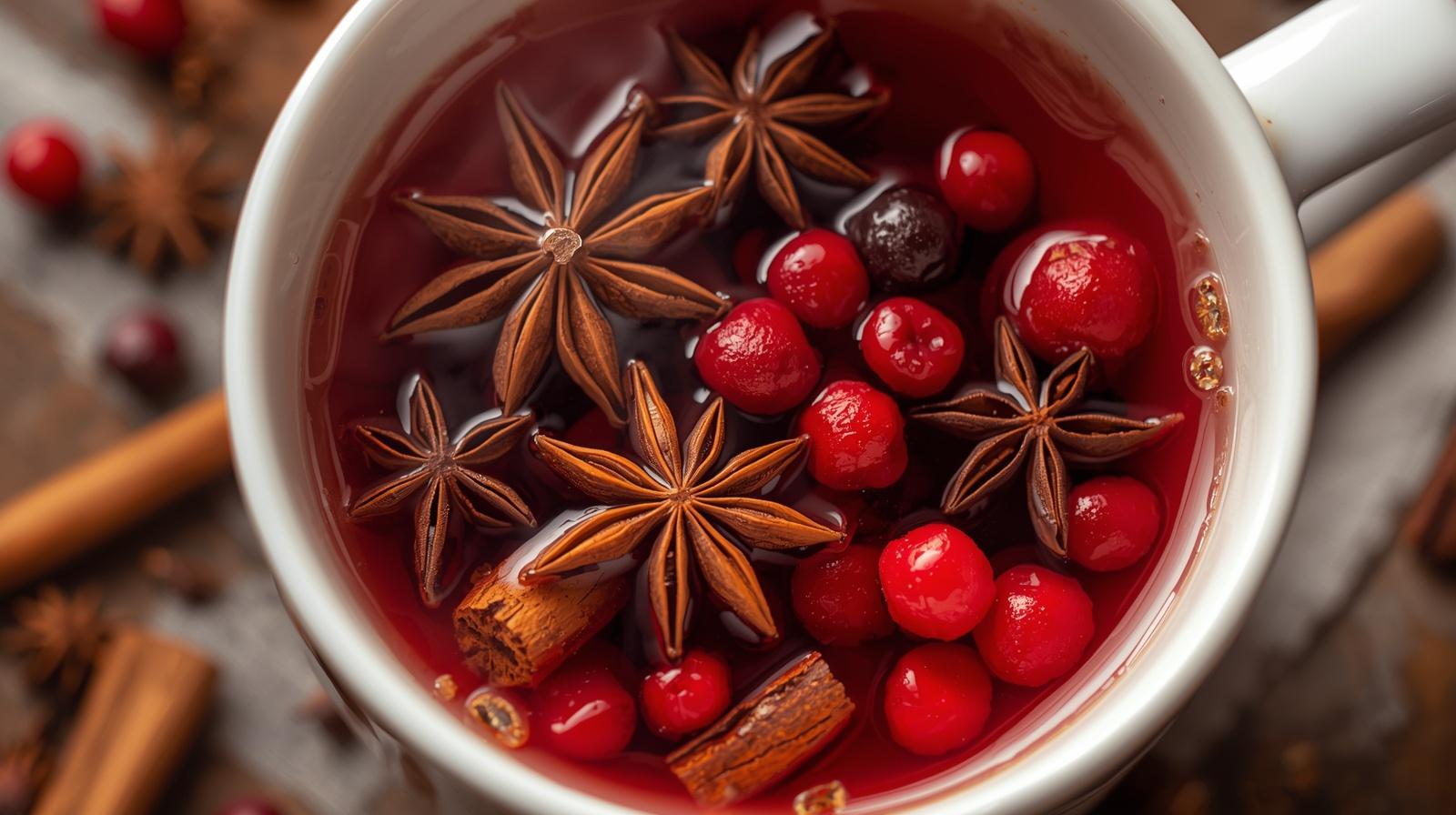
A deep-ruby daily brew that supports cardiovascular health, cools internal heat, regulates blood pressure, and brings the heart back into rhythm during perimenopause.
Prep time: 10 minutes | Daily serving: Up to 16 oz | Shelf life: 2 to 3 days at room temperature in summer; up to 1 week in winter
Dosha balance: Pitta cooling, Vata and Kapha warming
Best for: Heart palpitations, hot flashes, high blood pressure, joint inflammation, hormonal fluctuation, digestive sluggishness
What you need
- 1/4 cup dried organic hibiscus flower petals
- 30 hawthorn berries (organic if possible)
- 4 star anise (whole)
- 10 to 12 whole cloves
- 1/4 inch piece of Ceylon cinnamon bark (not cassia)
- 8 cups filtered water
- 10 to 12 dried goji berries per mug (added when serving, kept in the cup, not strained)
Simmer the first six ingredients together until steaming, strain, and store. Goji berries are added separately to each cup when you pour. They stay in your mug and you eat them.
Important: who should use caution with this tea
Blood pressure medication: Hibiscus and hawthorn both have clinically documented blood pressure lowering effects. If you are on antihypertensive medication, do not add this tea to your daily routine without consulting your healthcare provider first.
Anticoagulants: Hibiscus has mild blood-thinning properties. If you are taking warfarin, aspirin, or other blood thinners, check with your doctor before drinking this daily.
Heavy menstrual bleeding: Hibiscus acts as a mild emmenagogue, meaning it can stimulate or increase menstrual flow. If your periods during perimenopause are already heavy, pause this tea during your bleed and resume after.
Heart medication: Hawthorn berries interact with digoxin and other cardiac glycosides. If you are on heart medication, speak with your cardiologist before adding hawthorn to your routine.
Cinnamon type: Use Ceylon cinnamon bark (true cinnamon), not cassia cinnamon. Cassia contains high levels of coumarin which can be harmful to the liver in daily large doses.
When your body calls for this tea
- Heart palpitations or a racing heart, especially in the evening
- Frequent hot flashes or persistent internal heat
- Elevated blood pressure or cardiovascular concern
- Bloating, sluggish digestion, or heaviness after meals
- Joint pain or body-wide inflammation
- Low energy combined with hormonal fluctuation
- Feeling emotionally unsettled or anxious around the heart
About this recipe
This is a decoction, not a steep. You simmer these ingredients together until the water steams and turns a deep, dark ruby. The low, sustained heat extracts the active compounds from the hawthorn berries and cinnamon bark, which would not fully release in a standard tea steep. Hibiscus petals give the brew its color and tartness. Star anise and cloves bring warmth and digestive support. Hawthorn berries are the quiet anchor of the whole formula: one of the most researched cardiotonic botanicals available.
The method of making a large batch and letting it sit is intentional. Unlike black tea, this blend does not become bitter or lose potency over a few days. The hawthorn and hibiscus compounds are stable at room temperature for 2 to 3 days in summer and up to a week in cooler months.
Why this recipe supports you
- Reduces hot flash frequency through hibiscus phytoestrogenic and cooling action
- Supports healthy blood pressure through hibiscus anthocyanins and hawthorn flavonoids
- Calms heart palpitations, one of the most common and alarming perimenopause symptoms
- Protects cardiovascular health during the increased risk period of hormonal transition
- Reduces systemic inflammation through antioxidant-rich ingredients
- Supports liver estrogen detox, helping the body clear hormonal metabolites
- Balances blood sugar and metabolic health through cinnamon
- Eases digestive sluggishness and bloating through star anise and cloves
- Nourishes the emotional heart alongside the physical one (TCM Shen)
Why these ingredients belong together
This formula balances opposites with precision. Hibiscus is cooling and moves downward. Cloves and cinnamon bark are warming and move energy outward. Star anise is warming but also softening. Hawthorn berries sit at the center: tonifying the heart without strongly heating or cooling it. The result is a blend that neither overheats a Pitta-dominant woman nor leaves a Vata-dominant woman feeling cold and depleted.
Ingredients and their wisdom
Dried organic hibiscus flower petals (1/4 cup)
Thermal quality: Cooling. The most active ingredient in this formula for blood pressure and heat.
Ayurveda: Strongly pacifies Pitta; reduces excess heat from the blood and liver. Taste (Rasa): Sour, Astringent. In Ayurveda, hibiscus (Japakusum) is one of the primary Pitta-cooling botanicals. It clears excess heat from Rakta Dhatu (blood tissue), the tissue layer most implicated in hot flashes, redness, and inflammation. Its sour rasa stimulates liver function and supports Apana Vata, the downward-moving energy that governs elimination and menstrual regulation.
TCM: Nature: Cool. Meridian: Heart, Liver, Kidney. Clears Heat, nourishes Yin, supports Heart Qi, moves stagnant Blood. Hot flashes in TCM are understood as empty heat rising when the Yin cooling system is depleted. Hibiscus cools this rising heat and nourishes the Yin foundation that perimenopause erodes.
Nutrition: Key nutrients: Anthocyanins (delphinidin, cyanidin), quercetin, Vitamin C, protocatechuic acid. Multiple clinical trials confirm hibiscus tea reduces systolic blood pressure by an average of 7 to 8 points in women with mild to moderate hypertension, comparable in some studies to the drug captopril. A 2023 study found hibiscus calyx extract binds to estrogen receptor alpha and may function as nutrition-based support for estrogen receptor activity.
Hawthorn berries (around 30, organic if possible)
Thermal quality: Neutral to slightly warming. The heart tonic at the center of this formula.
Ayurveda: Hawthorn is classified as a Hridya herb in Ayurveda, meaning it specifically nourishes and strengthens the heart. It supports Vyana Vata, the subdosha responsible for circulation and the rhythmic movement of the heart. In Ayurveda, the heart is the seat of consciousness and prana, and herbs that nourish it strengthen both physical and emotional vitality simultaneously.
TCM: Nature: Slightly Warm. Meridian: Spleen, Stomach, Liver. In TCM, hawthorn (Shanzha) is considered a Shen tonic. Shen is the spirit that resides in the Heart, and when Shen is disturbed, the symptoms are anxiety, insomnia, restlessness, and palpitations. Hawthorn steadies Shen by strengthening the Heart Qi that houses it. It also moves Blood stagnation, a common pattern in perimenopausal women with irregular cycles, clotting, or poor circulation.
Nutrition: Key nutrients: Oligomeric procyanidins (OPCs), vitexin, hyperoside, quercetin, bioflavonoids. Hawthorn is one of the most extensively studied cardiotonic herbs in Western medicine. Clinical trials document its ability to reduce heart palpitations, improve cardiac output, lower diastolic blood pressure, and reduce fatigue in women with mild to moderate cardiovascular symptoms.
Star anise (4 whole)
Thermal quality: Warming. Digestive mover and mild phytoestrogenic support.
Ayurveda: Star anise (Chakraphool) is a Deepana and Pachana herb in Ayurveda, meaning it kindles digestive fire. In the context of this formula, it provides the warming movement that balances hibiscus's cooling nature, ensuring the brew does not over-cool a Vata-dominant woman.
TCM: Nature: Warm. Meridian: Kidney, Liver, Spleen. Star anise (Ba Jiao) warms the Kidney Yang and disperses cold in the lower abdomen. During perimenopause, many women experience a paradox of upper body heat (hot flashes) with lower body coldness. Star anise addresses the cold below while hibiscus and hawthorn address the heat above.
Nutrition: Star anise contains anethole, a compound with documented phytoestrogenic activity. Anethole binds weakly to estrogen receptors, providing mild estrogenic support during the declining estrogen phase of perimenopause. Note: use Chinese star anise (Illicium verum) only. Japanese star anise (Illicium anisatum) is toxic and must not be used.
Cloves (10 to 12 whole)
Thermal quality: Warming. Pain-relieving, antimicrobial, and blood sugar balancing.
Ayurveda: Cloves (Lavanga) are among the most heating spices in Ayurveda. In this formula, their quantity is balanced by the cooling hibiscus so the net effect remains neutral to mildly warming. Cloves are primarily used for pain, digestive fire, and as a penetrating carrier that helps other herbs move deeply into tissues.
TCM: Nature: Warm. Meridian: Kidney, Spleen, Stomach. Cloves (Ding Xiang) warm the Kidney Yang and the middle Jiao (digestive center). Their Kidney Yang-tonifying action supports libido, low back strength, and the bone-preserving function that becomes critical as estrogen declines.
Nutrition: Key nutrients: Eugenol, beta-caryophyllene, Vitamin C, manganese. Cloves have one of the highest antioxidant scores of any food. Eugenol is a potent anti-inflammatory and analgesic. Several clinical studies show cloves improve blood sugar regulation by improving insulin receptor activity, directly relevant to the metabolic changes of perimenopause.
Ceylon cinnamon bark (1/4 inch piece)
Thermal quality: Warming. Blood sugar regulation, circulation, and anti-inflammatory support.
Ayurveda: Cinnamon bark (Twak) is one of the great Ayurvedic Tridoshic spices when used in small amounts. It promotes circulation, improves digestive fire, and is specifically recommended in classical texts for managing perimenopausal Vata and Pitta imbalances. Its astringent quality provides grounding that balances the erratic movement of Vata during this transition.
TCM: Nature: Hot. Meridian: Heart, Lung, Bladder, Kidney. Cinnamon bark (Rou Gui) is one of TCM's most important Yang tonics. In this formula, it anchors the warmth provided by cloves and star anise, directing it into the lower body and away from the head, which can help prevent the upward rushing of heat that causes hot flashes.
Nutrition: Key nutrients: Cinnamaldehyde, procyanidins, Vitamin K, manganese. Use Ceylon (true cinnamon), not cassia. Ceylon cinnamon has strong evidence for improving insulin sensitivity and lowering fasting blood glucose. Cassia cinnamon contains high coumarin which can damage the liver in daily doses; Ceylon cinnamon bark has negligible coumarin and is safe for daily use.
Goji berries (10 to 12 per mug, added at serving, kept in the cup)
Thermal quality: Neutral. The nourishing anchor that makes everything else work more deeply.
Ayurveda: In Ayurveda, goji berries are Rasayana herbs: rejuvenating tonics that rebuild the deepest tissue layers and slow biological aging. They are Shukra Dhatu tonics, meaning they restore the reproductive tissue and the ojas that underlies immunity and hormonal resilience. In the context of this formula, their Rasayana quality complements the detoxifying action of hibiscus. Hibiscus clears excess heat and moves what has stagnated. Goji then steps in to nourish and rebuild. This is classical Ayurvedic sequencing: shodhana (cleansing) followed by rasayana (rebuilding).
TCM: Nature: Neutral. Meridian: Liver, Kidney, Lung. Gou Qi Zi has been a cornerstone of TCM formulation for over two thousand years. It belongs to the Tonic herbs for Yin Deficiency category, which is precisely the pattern that defines perimenopause in TCM. Kidney Yin is the cooling, moistening, anchoring force in the body. Hot flashes, night sweats, vaginal dryness, insomnia, thinning hair, aching lower back and weak knees: all are classical Kidney Yin Deficiency presentations, and all are within the scope of what Gou Qi Zi addresses.
Nutrition: Key nutrients: Lycium barbarum polysaccharides (LBP), zeaxanthin, lutein, beta-carotene, Vitamin C, Vitamin B6, zinc, selenium, betaine, 8 of 9 essential amino acids. A peer-reviewed study found that goji berry polysaccharides reduced anxiety behaviors in ovariectomized female rats by increasing serotonin receptor levels in the hippocampus. Because goji berries are added to each cup rather than simmered with the batch, they retain more of their delicate LBP polysaccharides and Vitamin C, both of which degrade with prolonged high heat.
Why these pairings work
Hibiscus and Hawthorn berries: Hibiscus cools and nourishes Yin, addressing the depleted cooling system that drives heat symptoms. Hawthorn tonifies the Shen and strengthens Heart Qi, addressing the palpitations and anxiety that arise when the heart loses its anchor during hormonal fluctuation. They work on the same organ system (Heart) through complementary mechanisms: hibiscus provides the fluid foundation, hawthorn provides the structural strength.
Hibiscus (Cooling) with Cloves and Cinnamon (Warming): The most important pairing logic in this recipe. Hibiscus is cooling and could, taken alone in quantity, over-cool the digestive system and aggravate Vata. Cloves and cinnamon bark provide warming counterweight. The net result is a brew that cools excess heat from the upper body (hot flashes, flushing) while keeping the digestive fire (agni) strong.
Star anise and Cinnamon bark (Metabolic support): Both improve insulin receptor sensitivity through different mechanisms: star anise through anethole's anti-inflammatory effect on glucose metabolism, and cinnamon through cinnamaldehyde's direct effect on insulin signaling. Perimenopause is a period of significant metabolic change as estrogen's protective role in glucose regulation diminishes.
How to make it
Step 1: Combine the ingredients
Add to a kettle or small pot: 1/4 cup dried organic hibiscus petals, 4 star anise, 10 to 12 whole cloves, a 1/4 inch piece of Ceylon cinnamon bark, and around 30 hawthorn berries. Cover with 8 cups of filtered water.
Step 2: Heat until steaming
Bring to a simmer and keep it there until the water steams, around 15 to 20 minutes. You are not boiling it hard; you are allowing a sustained low heat to draw the active compounds from the hawthorn berries and cinnamon bark. The water will turn a deep, dark ruby from the hibiscus.
Step 3: Strain and store
Strain out all the solids. Pour into a glass jar or pitcher. Leave it at room temperature uncovered if you will finish it within 2 to 3 days in summer, or cover and leave out for up to a week in cooler weather. This brew does not need to be refrigerated.
Step 4: Add goji berries to your mug
Goji berries are added to each cup separately. They are not simmered with the batch and they are not strained out. They stay in your cup and you eat them after you finish the tea. Choose the method that suits you:
- Drop 10 to 12 dried goji berries directly into your mug before pouring the hot tea over them. They will soften and plump as you drink. Eat them. This is the simplest method and the one closest to traditional Chinese practice.
- If you prefer them softer: simmer a small handful of goji berries (around 30 to 40) in 2 cups of water for 10 minutes. Store this goji concentrate in a small jar in the refrigerator. It keeps for 4 to 5 days. Add a splash to each mug when you pour.
- If you are reheating a cup: add the goji berries directly to the portion you are reheating and warm them together briefly.
In all three methods, eat the berries. In TCM and Ayurveda, the whole berry is the medicine.
Step 5: Pour and drink daily
Pour up to 16 oz per day, either in two servings of 8 oz or drunk slowly throughout the day. Pitta-dominant women (those who run hot) may prefer it at room temperature or cool. Vata-dominant women (those who run cold) should drink it warm.
When, how much, and how to receive it
Ideal timing: Morning and midday. Not late evening, as hawthorn and hibiscus are both mildly diuretic and energizing, which can disrupt sleep if taken after 5 pm. Many women find a cup first thing in the morning, before breakfast, particularly effective because the hibiscus is absorbed more efficiently on a lighter stomach.
How much: Up to 16 oz per day. Start with 8 oz per day for the first three to four days if you are new to hawthorn or have any cardiovascular sensitivity. Increase to 16 oz once you have confirmed your body responds well.
Vessel: A ceramic or glass kettle is ideal. Avoid aluminum, which can react with the acid in hibiscus. Stainless steel is fine.
Sweetening: This tea does not need sweetening. A small amount of raw honey added after cooling works well if you want a touch of sweetness. Do not add sugar, which would undermine the blood sugar-regulating effect of the cinnamon.
What to avoid alongside this tea
- Pharmaceutical diuretics or blood pressure medications without medical supervision
- Digoxin or other cardiac glycosides (hawthorn interaction)
- Drinking during heavy menstrual bleeding (hibiscus emmenagogue effect)
- Cassia cinnamon, which contains hepatotoxic coumarin at daily doses
- Japanese star anise (Illicium anisatum), which is toxic. Use only Chinese star anise (Illicium verum)
What to pair this ritual with
- A 10 minute morning walk, which amplifies the cardiovascular benefit
- Deep diaphragmatic breathing or Bhramari (humming bee) breath, which directly supports heart rhythm regulation
- Reducing processed salt and increasing potassium-rich foods alongside this tea for maximum blood pressure benefit
- A warm foot soak with Epsom salt in the evening, which complements the circulation support of this brew
How to use this over time
Days 1 to 4: Start with 8 oz per day. Observe how your body responds. Note any changes in blood pressure, digestion, energy, or palpitation frequency.
Day 5 onward: Increase to 16 oz per day if well-tolerated, split across the morning and midday.
After 4 weeks: Hawthorn's cardiovascular effects are measurable by this point. Most women notice reduced hot flash frequency and improved digestion within the first two weeks.
Notice what shifts over the first month: hot flash frequency and intensity, heart palpitation frequency, blood pressure (if you track it), digestion and bloating after meals, joint comfort and inflammation, energy levels in the morning, and emotional steadiness around the heart.
Common questions
Can I drink this if I have low blood pressure? Use caution. Both hibiscus and hawthorn lower blood pressure. If your blood pressure is already on the lower side (below 110/70), start with a smaller amount, around 4 oz per day, and monitor how you feel. Dizziness or lightheadedness upon standing is a signal to reduce the dose.
Can I drink this hot in winter? Yes. Warming this brew gently is perfectly fine and is actually the preferred way to take it in cooler months or for Vata-dominant women. Do not boil it again after the initial preparation as repeated boiling degrades the hibiscus anthocyanins. Warm it gently over low heat.
The hibiscus makes it very tart. Is that normal? Yes. Hibiscus has a naturally sour, astringent flavor. The tartness confirms the anthocyanin content is present. If it is too sharp for you, reduce the hibiscus to 3 tablespoons instead of 1/4 cup, or add a small piece of fresh apple to the pot while simmering.
Can I add other herbs to this formula? The formula is already balancing several thermal qualities and organ systems. Adding more herbs without understanding how they interact is not recommended. One safe addition for Vata-dominant women who run cold is a 1/4 teaspoon of fresh ginger added during simmering.
Is this safe during perimenopause if I am on HRT? For most women, yes. This is a food-grade botanical blend at culinary and low therapeutic doses. The main interaction to watch for is the blood pressure lowering effect if you are taking any cardiovascular medication alongside HRT. Inform your doctor that you are drinking this daily.
How long can I continue drinking this? This is designed as a long-term daily tonic, not a short-term cleanse. Hawthorn in particular is safest and most effective with consistent long-term use. There is no documented upper limit on duration for the ingredients at these doses.
Sources and references
Najaf Najafi M et al. Effect of Hibiscus sabdariffa on blood pressure in patients with stage 1 hypertension. Journal of Advanced Pharmaceutical Technology and Research. 2016.
Lorenzana-Martinez M et al. Hibiscus calyx extract binds to estrogen receptor alpha and promotes memory in ovariectomized mice. Nutrients. 2023.
Wirtz PH et al. Real world effectiveness of hawthorn special extract WS 1442. Scientific Reports. 2024.
Tassell MC et al. Hawthorn (Crataegus spp.) in the treatment of cardiovascular disease. Pharmacognosy Reviews. 2010.
Gruenwald J et al. Cinnamon and health. Critical Reviews in Food Science and Nutrition. 2010.
Bhatt ID et al. Medicinal value of star anise (Illicium verum). Pharmacognosy Communications. 2013.
Frawley D, Lad V. The Yoga of Herbs: An Ayurvedic Guide to Herbal Medicine. Lotus Press. 1986.
Pehlivan Karakas SP et al. Anxiolytic, antioxidant, and neuroprotective effects of goji berry polysaccharides in ovariectomized rats. Frontiers in Neuroscience. 2020.
Amagase H, Farnsworth NR. A review of botanical characteristics of Lycium barbarum fruit (goji). Food Research International. 2011.
Maciocia G. The Practice of Chinese Medicine. Churchill Livingstone. 2008.