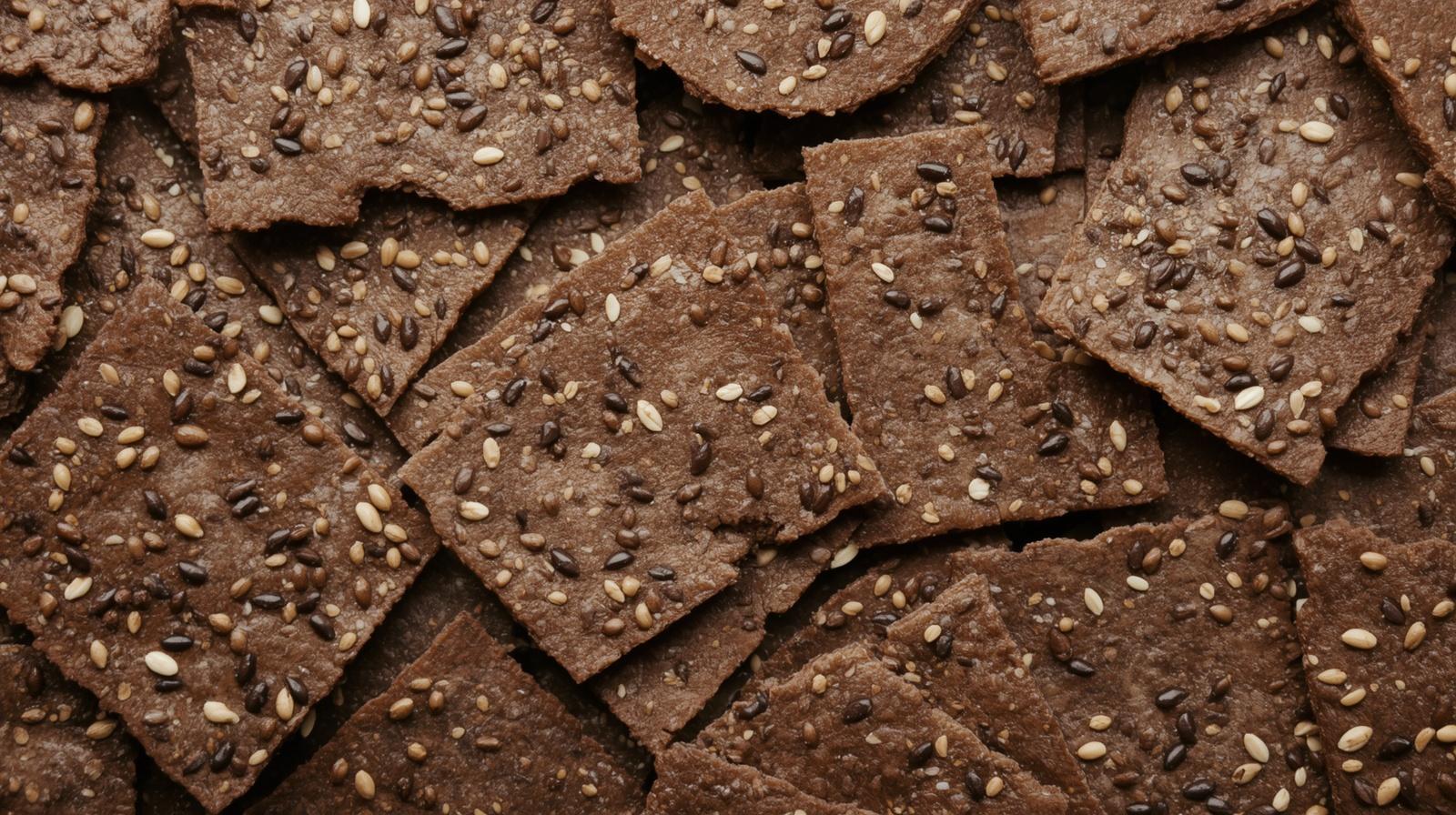
A bone-building, hormone-supporting snack made from the most calcium-dense grain in the world, two of the most researched phytoestrogen seeds, and spices that have supported women's health for millennia.
15 minutes
20 minutes in the air fryer at 360 F
Approximately 20 to 25 thin crackers
5 to 7 days in an airtight container
Bone density support, hormone balance, blood sugar stability
What you need
Measure everything before you start. The dough comes together quickly.
Dry ingredients
- --1 cup ragi flour (finger millet flour)
- --1/2 cup coarse whole wheat flour (the kind used for bhakari or chapati, not fine-milled; the coarseness gives the cracker its crunch)
- --2 tablespoons sesame seeds (black, white, or a mix of both)
- --1 tablespoon flax seeds
- --2 teaspoons cumin powder or roasted cumin powder
- --1 teaspoon black pepper powder
- --1 and a half teaspoons sea salt
- --A pinch of baking soda (optional, for extra crispiness)
Wet ingredients
- --Roughly 1/4 cup coconut oil (solid or melted; if solid, rub it into the flour as you would butter)
- --Enough water to bring the dough together, added gradually, a tablespoon at a time
The dough should not be sticky. It should be firm enough to roll out thin and hold its shape. Start with 3 to 4 tablespoons of water and add more only as needed.
When this snack belongs in your day
- ◆Midmorning or midafternoon when you need something that sustains without spiking blood sugar
- ◆Alongside a meal as a crunch element with dips, hummus, or a wedge of cheese
- ◆When you want something satisfying that actively supports bone density
- ◆As a daily habit for perimenopausal women building toward long-term skeletal health
- ◆When you are watching blood sugar and need a low-glycemic, high-fiber option
About this recipe
This cracker was designed around one question: what is the most nourishing thing a perimenopausal woman could put in her hand to eat while standing at the kitchen counter? The answer turned out to be this. Ragi, with 344 mg of calcium per 100 grams, is the most calcium-dense plant food available, with a calcium content 5 to 50 times higher than other cereals. Combined with flax seeds, the most abundant plant source of lignans and one of the most studied foods for reducing perimenopausal symptoms, and sesame seeds, whose lignans have been clinically shown to improve sex hormone status and blood lipid profiles in postmenopausal women, the combination covers the two most significant biological concerns of perimenopause: bone loss and hormonal fluctuation.
The coarse whole wheat flour (the kind used in Indian homes for chapati and bhakari, not the fine Western variety) is what gives these crackers their characteristic crunch. It resists becoming soft and chewy in the way fine flour does. Coconut oil provides healthy saturated fat for sustained energy and helps bind the dough without eggs or dairy. Cumin supports digestion. Black pepper amplifies the absorption of other nutrients. Sea salt provides trace minerals. Everything in this cracker is doing something.
The air fryer method is genuinely the best approach here. If you have the plate designed specifically for the air fryer, a solid flat surface, you will need to flip the crackers at the midpoint, around 10 minutes in, so both sides cook evenly. If you have a mesh or perforated basket where the air circulates underneath as well, both sides crisp simultaneously and no flipping is needed.
Why this recipe supports you
- ◆Ragi provides 344 mg of calcium per 100 grams, the highest plant source available, directly addressing the bone density loss that begins in perimenopause
- ◆Flax seeds contain lignans that reduce hot flash frequency and intensity in clinical trials
- ◆Sesame lignans support estrogen metabolism and improve blood lipids in postmenopausal women
- ◆Coconut oil provides medium-chain fatty acids for sustained energy and hormonal raw material
- ◆Cumin supports digestion and liver function, both critical for hormone processing
- ◆Black pepper contains piperine, which enhances the absorption of multiple nutrients including calcium
- ◆Ragi has a low glycemic index, supporting blood sugar stability through the metabolic shifts of perimenopause
- ◆Sea salt provides trace minerals including magnesium and potassium, both important for bone and cardiovascular health
Why these ingredients work together
Every cracker recipe has flour, fat, and seasoning. This one is built differently. Each ingredient was chosen because it does something specific for the perimenopausal body.
Ragi and sesame are a classical pairing in South Indian cooking, not by accident. Ragi provides the calcium. Sesame provides sesamin, a lignan that improves how the body metabolizes and uses that calcium while simultaneously supporting estrogen receptor activity. They have been eaten together for generations in Karnataka and Tamil Nadu, in ragi balls rolled in sesame, in millet porridges finished with sesame oil. The body knows this combination.
Flax seeds add the third layer: omega-3 fatty acids and the most potent plant lignans available. When flax and sesame lignans are consumed together, they both convert to enterolactone and enterodiol in the gut, creating a combined phytoestrogenic effect that neither seed achieves alone at these small amounts. The two seeds work the same pathway and reinforce each other.
Coconut oil binds the dough and provides medium-chain triglycerides, which the body metabolizes differently from long-chain fats: directly to energy rather than stored as fat, relevant for the metabolic changes of perimenopause. Cumin's volatile oils support the digestion and liver function that process these hormonal compounds. Black pepper's piperine enhances bioavailability across the board. This is not a collection of healthy ingredients. It is a formulation that eats like a snack.
Ingredients and their wisdom
Ragi flour (1 cup, finger millet)
Thermal quality: Cooling. The calcium foundation of this recipe.
Ayurveda
Quality: Light (Laghu), Dry (Ruksha), Cool (Shita). Dosha effect: Reduces Pitta and Kapha; pacifies Vata in moderation. Taste (Rasa): Sweet, Astringent. In Ayurveda, ragi is classified as a Shali-varga grain and is considered Asthiposaka (nourishing to bone tissue, or Asthi Dhatu). The Ayurvedic understanding that ragi strengthens Asthi Dhatu maps directly onto its calcium content: Ayurveda recognized the grain's bone-building action through centuries of clinical observation before the calcium mechanism was understood by Western science.
TCM
Nature: Neutral to Cool. Meridian: Spleen, Stomach, Liver. Action: Nourishes the middle Jiao, supports the Spleen's transforming function, clears Heat from the Blood. In TCM, millet grains are considered among the most nourishing grains for the Spleen and Stomach. During perimenopause, when the Spleen often becomes depleted under the burden of stress and hormonal fluctuation, ragi's neutral to cooling nature and easy digestibility make it a core restorative food.
Nutrition
Ragi contains 344 mg of calcium per 100 grams according to the National Institute of Nutrition (ICMR), making it the highest non-dairy plant source of calcium available and containing 5 to 50 times more calcium than other cereals including rice, corn, and wheat. This calcium is accompanied by co-factors that improve its bioavailability: the phosphorus, magnesium, and amino acids present in whole ragi flour support absorption in ways that isolated calcium supplements cannot replicate. Plant-based calcium from ragi does not trigger the bone resorption response that animal protein can cause, making the calcium gained from ragi truly additive.
Sesame seeds (2 tablespoons)
Thermal quality: Warming. Phytoestrogenic lignan source and bone mineral supporter.
Ayurveda
Quality: Heavy (Guru), Oily (Snigdha), Warming (Ushna). Dosha effect: Nourishes Vata strongly; reduces Kapha and Pitta in moderation. Sesame (Tila) holds one of the highest places in Ayurvedic dietary medicine. It is classified as Medhya (beneficial for the mind), Balya (strengthening tonic), and Vrushya (reproductive tonic). Sesame's heavy, oily qualities directly counteract the dryness and depletion of Vata that characterizes perimenopause: dry skin, dry joints, dry vaginal tissue, the thin and brittle quality that hormonal decline brings.
TCM
Nature: Neutral to Slightly Warm. Meridian: Liver, Kidney, Large Intestine. Action: Nourishes Liver and Kidney Yin, lubricates the intestines, nourishes Blood, supports Jing. Black sesame seeds (Hei Zhi Ma) are a classical Jing tonic in TCM, used specifically to address the depletion of Kidney and Liver Essence that underlies aging and the perimenopausal transition.
Nutrition
A randomized controlled crossover study in postmenopausal women found that consuming sesame powder daily for five weeks improved sex hormone status, antioxidant capacity, and blood lipid profiles. Sesamin, the primary lignan in sesame, is converted by gut bacteria to enterolactone, a compound with estrogenic activity that binds to estrogen receptors and provides mild hormonal support during the transition. Sesame's calcium content is extraordinary: up to 975 mg per 100 grams for black sesame, making it a significant calcium source in its own right alongside ragi.
Flax seeds (1 tablespoon)
Thermal quality: Neutral to slightly warming. The most potent plant lignan source available.
Ayurveda
Quality: Heavy (Guru), Oily (Snigdha), slightly Warm (Ushna). Dosha effect: Strongly nourishes Vata; reduces dryness and depletion. Flax seeds (Alsi) are classified as Vrushya (reproductive tonics) and Vata-pacifying foods of the highest order. Their heavy, oily quality directly addresses the systemic dryness that characterizes advanced Vata imbalance: dry skin, dry hair, dry joints, dry mucous membranes.
TCM
Nature: Neutral. Meridian: Lung, Large Intestine, Liver. Action: Moistens the intestines, nourishes Blood, lubricates dry tissues. When used alongside sesame seeds, flax seeds contribute to the same Yin and Blood-nourishing pattern, making the combination synergistic in TCM terms.
Nutrition
Flax seeds are the most abundant dietary source of lignans by a significant margin, containing 75 to 800 times more lignans than other seeds, vegetables, and legumes. A randomized controlled study published in PMC found that three months of flaxseed supplementation significantly reduced perimenopausal symptoms and substantially increased blood levels of enterodiol and enterolactone, the mammalian lignan metabolites with documented phytoestrogenic activity. Participants showed an average reduction of more than 47 percent in menopausal symptom scores. One tablespoon of flax seeds in a cracker recipe is a small but daily and cumulative dose. Consistency matters more than quantity for lignan effects.
Coconut oil (roughly 1/4 cup)
Thermal quality: Slightly cooling to neutral. The binder and energy source.
Coconut oil (Narikela Taila) is one of Ayurveda's most important culinary oils, classified as cooling, nourishing, and Ojas-building. In TCM, it moistens and nourishes tissues. Nutritionally, coconut oil's medium-chain triglycerides (MCTs) are metabolized differently from long-chain fats: they go directly to the liver for rapid energy conversion rather than being stored. This makes coconut oil a particularly appropriate fat for perimenopausal women experiencing the metabolic slowdown that comes with estrogen decline. MCTs have also been studied for cognitive support, relevant given the brain fog many perimenopausal women experience. The solid fat structure of coconut oil also helps these crackers hold their shape during air frying.
Spices: cumin, black pepper, sea salt
These are not decorative. Each does functional work.
Cumin (2 teaspoons): In Ayurveda, cumin (Jeeraka) is a premier Agni-stimulating, liver-supporting digestive spice. It improves the absorption of calcium and minerals from food, supports the liver in its role of hormone metabolism, and reduces bloating. Roasted cumin has a deeper, nuttier, slightly smoky flavor. Either works; roasted gives slightly more Agni-stimulating quality and a more developed flavor.
Black pepper (1 teaspoon): Piperine, the active compound in black pepper, has been shown to increase the absorption of minerals including calcium by up to 20 percent through its effect on gut absorption mechanisms. Adding black pepper to a calcium-rich cracker is the equivalent of adding Vitamin D to a calcium supplement: it closes the loop between ingesting calcium and actually absorbing it. This pairing is classical in Indian cooking, where black pepper appears in virtually every ragi and millet preparation.
Sea salt (1 and a half teaspoons): Unrefined sea salt provides trace minerals including magnesium, potassium, iodine, and over 80 additional trace minerals in small amounts. These minerals support bone matrix formation alongside calcium, adrenal function during the high-demand period of perimenopause, and thyroid function. The amount here is appropriate for a batch of 20 to 25 crackers and provides approximately 65 mg of sodium per cracker.
How to make them
Combine the dry ingredients
In a mixing bowl, combine the ragi flour, coarse wheat flour, sesame seeds, flax seeds, cumin powder, black pepper powder, sea salt, and baking soda if using. Mix thoroughly with your hands or a spoon so the seeds and spices are evenly distributed through the flour. This is important: uneven distribution means some crackers will be spicier or blander than others.
Work in the coconut oil
Add the coconut oil. If it is solid, rub it into the flour with your fingertips, working it through until the mixture resembles coarse crumbs, the way you would work butter into pastry. If it is melted, pour it in and mix. The dough should look crumbly but hold together when you press a handful. This rubbing-in technique is what creates the flaky, crisp texture in the final cracker.
Add water, rest, and knead again
Add water one tablespoon at a time, mixing after each addition. You are looking for a dough that holds together when pressed into a ball but is not sticky. Start with 3 tablespoons and work up from there. Ragi flour absorbs water more slowly than wheat, so give it a moment after each addition before deciding you need more. Too much water makes the crackers soft and chewy rather than crisp. Once the dough comes together, cover it and let it rest for 15 minutes. After 15 minutes, knead the dough again for about a minute. You will notice it becomes smoother and more pliable. Do not skip this step. Rested dough rolls thinner without cracking at the edges.
Dust, roll out thin, and cut
Divide the rested dough into small balls, roughly the size of a large lime. Before rolling, lightly dip each ball into a small bowl of flour. This dusting prevents the dough from sticking and is what allows you to roll it genuinely thin without it tearing. Roll each ball out into a round, the way you would roll a bhakari or a thin chapati. Aim for 2 to 3 mm thickness. Once you have your round, cut it into crackers using a knife, pizza cutter, or pastry wheel. Do not worry about making perfectly uniform shapes. The rustic, uneven shapes are part of what makes these feel homemade rather than commercial.
Place in the air fryer
If you have a solid flat plate: the hot air circulates around the crackers but the bottom sits on the plate. Flip the crackers at the halfway point, around 10 minutes in, so both sides cook evenly. If you have a mesh or perforated basket where air can circulate from underneath as well: both sides crisp simultaneously and no flipping is needed.
Air fry at 360 F for 20 minutes, then cool
Air fry at 360 degrees Fahrenheit (approximately 180 degrees Celsius) for around 20 minutes. Check at 15 minutes: crackers on the thinner edges of the batch may be done earlier. They are ready when they feel firm and dry to the touch and have taken on a slightly darker color. They will crisp further as they cool, so do not judge the final texture while they are still hot. Let the crackers cool on a rack or flat surface for at least 10 minutes before tasting or storing. Store in an airtight container at room temperature for 5 to 7 days.
Ritual guidance: when and how to eat these
When
These crackers are best eaten between meals rather than with a main meal. The calcium in ragi is absorbed more efficiently when it is not competing with phytic acid in other grains or oxalates in cooked greens. A standalone snack means a cleaner absorption window. Eating them between meals also stabilizes blood sugar during the troughs that perimenopausal women often experience in the late morning and mid-afternoon.
How much
Three to five crackers is a meaningful serving. If you are eating them as a bone-support daily practice, consistency matters more than quantity: a few crackers every day for months is more effective than a large serving once a week.
What to pair with
- ◆Hummus: the tahini adds more sesame lignans, and chickpea protein complements the amino acid profile of ragi
- ◆Nut butter: almond or cashew butter provides additional calcium and healthy fat that enhances absorption
- ◆Soft cheese: the combination of ragi calcium and dairy calcium provides a very high single-serving calcium dose
- ◆Plain yogurt with a drizzle of honey: probiotics support the gut microbiome that converts lignan precursors into their active forms
- ◆Avocado: healthy fat enhances absorption of fat-soluble sesame Vitamin E and supports hormonal health
What to avoid pairing with
- --Coffee or black tea immediately before or after: tannins in both beverages inhibit non-heme iron and calcium absorption
- --High-oxalate foods like spinach at the same time: oxalates bind calcium and reduce absorption
Variations
This recipe is a foundation. Once you have made it once, it is easy to adjust.
- ◆Swap roasted cumin for ajwain (carom seeds) for a more digestive and aromatic cracker
- ◆Add a teaspoon of turmeric for additional anti-inflammatory benefit and color
- ◆Replace some of the water with buttermilk or thin lassi: the lactic acid activates the baking soda more effectively and adds a slight tang
- ◆Add two tablespoons of nutritional yeast for a savory, slightly cheesy note and additional B vitamins
- ◆For a sweeter version to eat with fruit or yogurt, omit the cumin and pepper and add a teaspoon of cinnamon and a tablespoon of jaggery
Common questions
Can I use an oven instead of an air fryer?
Yes. Bake at 350 degrees Fahrenheit (175 degrees Celsius) on a parchment-lined baking sheet for 20 to 25 minutes, flipping once at 12 minutes. The result will be slightly less even than the air fryer but still very good. Watch them closely in the last 5 minutes as ragi can go from perfectly done to over-browned quickly.
Do the flax seeds need to be ground?
For this recipe, whole flax seeds work fine because the high temperature of the air fryer cracks the seed coating and releases the active compounds during baking. If you want maximum lignan absorption, you can grind one tablespoon of flax seeds before adding them to the dough. Ground flax integrates invisibly into the cracker. Whole seeds stay visible and add a pleasant texture.
Why coarse wheat flour specifically?
Fine wheat flour produces a softer, more biscuit-like texture that loses its crunch quickly. The coarse flour used for Indian flatbreads has higher bran content and a larger particle size that resists becoming soft after baking. It also has a lower glycemic index than fine flour. If you cannot find coarse whole wheat flour, look for whole wheat atta at any Indian grocery. Do not substitute with all-purpose flour, which will make a soft and crumbly cracker rather than a crisp one.
Can I make these gluten-free?
Yes. Replace the coarse wheat flour with an equal amount of ragi flour (making the total 1 and a half cups of ragi) or with buckwheat flour, which also has a robust flavor and crunch. The texture will be slightly more fragile without the gluten structure of wheat, so handle the rolled dough carefully.
How do I know they are done?
They should feel firm and dry when you press them, not at all soft or yielding. They will look slightly darker than when they went in. Remember that they crisp further as they cool. If in doubt, take one out and let it cool for two minutes before testing. An underdone cracker will still be slightly flexible when hot but firm up as it cools.
Sources and references
Jagati P, Mahapatra I, Dash D. Finger millet (Ragi) as an essential dietary supplement with key health benefits: a review. International Journal of Home Science. 2021.
Warhade S, Atram P, Sawarkar N. Finger Millet (Ragi): A Nutritional Boon for Osteoporosis. International Journal for Research in Applied Science and Engineering Technology. 2023.
Puranik DB, Math MV. Utility of Finger Millet (Ragi) in post-menopausal osteoporosis: a review. World Journal of Pharmaceutical Research. 2024.
Wu WH et al. Sesame ingestion affects sex hormones, antioxidant status, and blood lipids in postmenopausal women. Journal of Nutrition. 2006.
Parikh M et al. Effects of Flaxseed on Perimenopausal Symptoms: Findings from a Single-Blind, Randomized, Placebo-Controlled Study. PMC. 2024.
Ghazanfarpour M et al. Effects of flaxseed and Hypericum perforatum on hot flash, vaginal atrophy and estrogen-dependent cancers in menopausal women. Avicenna Journal of Phytomedicine. 2016.
Shoba G et al. Influence of piperine on the pharmacokinetics of curcumin in animals and human volunteers. Planta Medica. 1998.
National Institute of Nutrition (ICMR). Calcium Rich Food Items: Nutrient per 100g of Edible Portion. Indian Council of Medical Research, Hyderabad.
Frawley D, Lad V. The Yoga of Herbs: An Ayurvedic Guide to Herbal Medicine. Lotus Press. 1986.
Maciocia G. The Practice of Chinese Medicine. Churchill Livingstone. 2008.
Bloom in the pause.