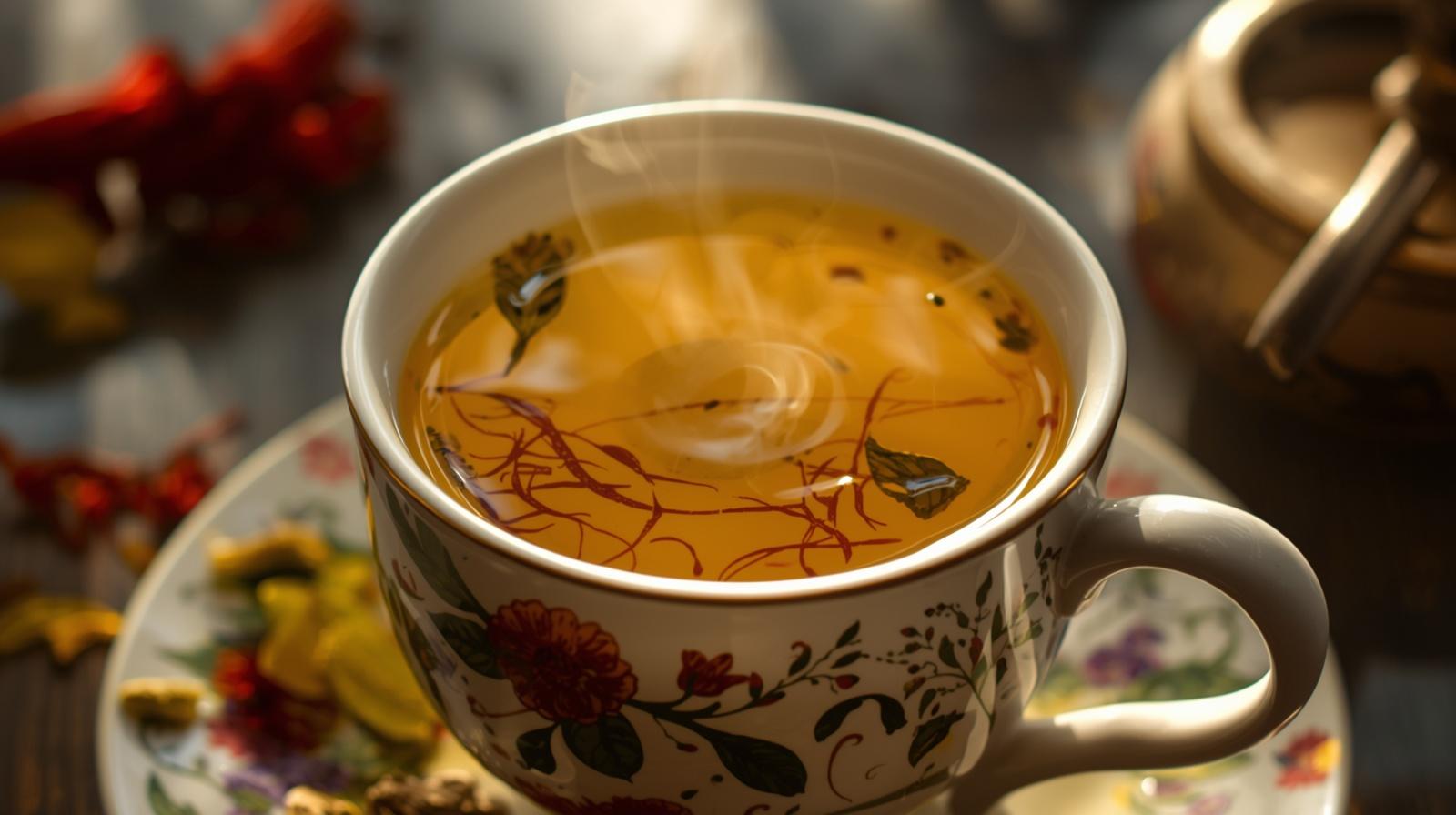
Shared by Dr. Laila Faizi Sohail. Green tea brewed with cardamom and saffron, steeped for at least 15 minutes before drinking. A daily brew from Afghan and Central Asian tradition that brings together three of the most studied botanicals for mood, hormonal balance, and cognitive health.
2 minutes
At least 15 minutes, covered
1 liter (one full kettle)
Mood support, anxiety, cognitive clarity, hormonal balance, bone density
What you need
- --1 teaspoon loose-leaf green tea
- --A pinch of cardamom powder
- --4 to 8 saffron threads
- --1 liter boiling water
Boil the water. Add the green tea, cardamom, and saffron to a teapot, thermos, or heatproof vessel. Pour the boiling water over everything. Cover tightly and leave it to steep for at least 15 minutes before drinking. The saffron needs time to release its active compounds fully into the hot water. The brew will turn a beautiful pale gold.
The 15-minute steep is not optional
This is how Dr. Laila makes it, and the science supports the method. Saffron's primary active compounds, safranal and crocin, need sustained hot-water contact to extract fully. A quick 3-minute steep produces a fraction of the benefit. Cover the vessel to retain heat and volatile oils throughout the steep.
Saffron caution
Saffron has mild blood-thinning properties and should not be taken in large amounts during active heavy bleeding or by anyone on anticoagulant medication. The 4 to 8 threads used here is a culinary and therapeutic dose well within safe range for most people. Do not exceed this amount.
A note from Dr. Laila Faizi Sohail
Dr. Laila Faizi Sohail trained in medicine at Uludag University in Bursa, Turkey, and practiced as an emergency room doctor in Turkish hospitals before moving to the United States, where she served as Associate Medical Director at Pfizer. Originally from Afghanistan, she is currently taking a break from clinical work to focus on further studies.
Saffron green tea is a daily brew in Afghan and broader Central Asian culture. Saffron is not a luxury ingredient in Afghanistan: it is a staple. The country produces some of the finest saffron in the world, and it enters the kitchen and the cup as naturally as any other spice. This tea is how Dr. Laila drinks green tea. Not plain. With cardamom to warm it and saffron to deepen it. Steeped long enough to mean something.
About this recipe
This is a brew from one of the world's great saffron cultures. Afghanistan produces saffron of extraordinary quality, and it has been woven into Afghan cooking, hospitality, and daily ritual for centuries. Saffron tea, particularly green tea with saffron, is a common morning drink across Afghanistan, Iran, and parts of Central Asia. The addition of cardamom is classical in this tradition: it rounds the slight bitterness of the green tea, warms a brew that might otherwise be too cooling for some constitutions, and bridges the flavors of the two main ingredients.
What makes this particular combination scientifically interesting is that each of the three ingredients has been independently studied for perimenopause-relevant actions, and they work through complementary rather than overlapping pathways. Green tea's EGCG supports bone density, cardiovascular health, and cognitive function through antioxidant and anti-inflammatory mechanisms. Saffron's crocin and safranal support mood, reduce anxiety and depression, and have documented effects on hot flash frequency and sexual function. Cardamom reduces cortisol and supports the parasympathetic nervous system. Together they address mood, cognition, bone health, hormonal balance, and stress response in a single morning cup.
The long steep is the method Dr. Laila describes: at least 15 minutes, covered, before drinking. Saffron's active compounds extract slowly. Green tea's EGCG and L-theanine are more robust but also benefit from a longer steep. The covered vessel keeps the heat in and prevents the volatile aromatic compounds from escaping. What you pour after 15 minutes is a fundamentally different brew from what you would pour after three.
Why this recipe supports you
- ◆Saffron crocin reduces hot flash frequency and improves mood in perimenopausal women
- ◆Saffron safranal has documented antidepressant effects comparable to low-dose conventional antidepressants in some trials
- ◆Green tea EGCG supports bone mineral density, particularly valuable when started before menopause
- ◆Green tea L-theanine provides calm, sustained alertness without cortisol spikes
- ◆Cardamom reduces cortisol and activates the parasympathetic nervous system
- ◆Cardamom balances green tea's Vata-aggravating tendency, making it suitable for all constitutions
- ◆Saffron supports serotonin and dopamine pathways, addressing the mood disruption of perimenopause
- ◆Green tea supports healthy metabolism and blood sugar regulation
- ◆The 15-minute steep maximizes extraction of all active compounds from all three ingredients
- ◆Caffeine is present but moderated by L-theanine and the long steep time
Ingredients and their wisdom
Green tea (1 teaspoon loose-leaf)
Thermal quality: Cooling. The cognitive, cardiovascular, and bone-protective foundation.
Green tea (Camellia sinensis, minimally processed) provides EGCG, one of the most studied polyphenols in botanical medicine. For perimenopausal women, its most clinically relevant actions are bone protection (EGCG inhibits osteoclast activity while supporting osteoblasts, directly counteracting estrogen-driven bone loss), cardiovascular support (systematic reviews show green tea extract significantly lowers LDL cholesterol and diastolic blood pressure), and cognitive clarity (L-theanine crosses the blood-brain barrier and modulates alpha brain wave activity, producing calm alertness without the cortisol spike of caffeine alone).
Ayurveda
Green tea's bitter and astringent qualities reduce Pitta and Kapha but can aggravate Vata with daily use over time. Cardamom is specifically in this formula to counterbalance that tendency.
TCM
Green tea (Lu Cha) clears Heat, moves Liver Qi, and calms the Shen, addressing the irritability, heat, and emotional volatility of the perimenopausal transition. The long steep extracts more L-theanine and catechins than a standard short steep, producing a more therapeutically complete brew.
Saffron (4 to 8 threads, Crocus sativus)
Thermal quality: Warming. The mood, hormone, and spirit medicine of this formula.
Saffron is one of the most researched botanical medicines for mood and perimenopause. Its primary active compounds, crocin, crocetin, and safranal, act on serotonin, dopamine, and GABA pathways simultaneously. Multiple randomized controlled trials have found saffron extract comparable to low-dose antidepressants for mild to moderate depression, with fewer side effects. A 2017 clinical study found that saffron supplementation reduced hot flash frequency and severity in perimenopausal women.
Afghanistan produces some of the world's finest saffron, particularly from the Herat region. In Afghan and Persian culture, saffron enters the daily cup naturally. The research on saffron's antidepressant and anxiolytic effects shows cumulative benefit with regular daily use. Four to eight threads in a liter of green tea provides a gentle, consistent daily dose.
Ayurveda
Saffron (Kumkuma) is classified as one of the most important herbs for the mind (Medhya), the heart (Hridya), and the female reproductive system (Artava Shodhaka). It is warming, blood-moving, and tissue-nourishing.
TCM
Saffron (Xi Hong Hua) invigorates Blood, moves Qi stagnation in the Liver, and calms the Shen. The Liver Qi stagnation of perimenopause, manifesting as irritability, emotional volatility, tight chest, and irregular periods, is one of saffron's primary indicated patterns.
Cardamom (a pinch of powder)
Thermal quality: Warming to the digestive system. The governing carrier that makes this formula work for all constitutions.
Cardamom (Ela in Ayurveda, Bai Dou Kou in TCM) appears in this formula for the same reason it appears in the saffron milk and the green tea lemon brew: it is the classical Anupana, the carrier herb, that governs the energetics of the formula and ensures it reaches its intended depth. Green tea is cooling and drying. Saffron is warming. Cardamom bridges them and ensures the formula is suitable for all constitutions.
Cardamom's cineole content reduces cortisol at the adrenal level and activates the parasympathetic nervous system, providing a biochemical complement to L-theanine's central nervous system calming action. The pinch used here is small and its flavor is subtle: it rounds the green tea and lifts the saffron rather than announcing itself.
The 15-minute steep: why it matters
Most green tea guidance suggests 2 to 3 minutes of steeping to avoid bitterness. Dr. Laila's method is 15 minutes, covered, before drinking. This is the Afghan and Central Asian approach to brewing saffron tea, and it reflects how saffron actually works.
Saffron threads release their active compounds slowly. Crocin, the primary mood-active compound, extracts gradually into hot water over time. A 3-minute steep yields a visually pale brew with limited crocin content. A 15-minute covered steep produces the characteristic deep gold color and a substantially more concentrated therapeutic extract. The covering retains heat and prevents safranal, the volatile aromatic compound responsible for saffron's mood effects, from escaping with the steam.
Green tea also benefits from the longer steep, extracting more L-theanine and a fuller catechin profile. The flavor does become more robust and slightly more bitter with a long steep, which the cardamom and saffron balance. If the flavor is too strong, reduce the green tea to half a teaspoon rather than reducing the steep time.
How to make it
- 1Bring 1 liter of water to a full boil.
- 2Place 1 teaspoon of loose-leaf green tea, a pinch of cardamom powder, and 4 to 8 saffron threads into a teapot, thermos, or heatproof vessel with a lid.
- 3Pour the boiling water over the ingredients.
- 4Cover tightly immediately. Do not open the lid during steeping.
- 5Leave for at least 15 minutes without disturbing. The brew will turn a warm golden color as the saffron releases.
- 6Strain if using loose tea and pour into a cup. Drink warm. This brew keeps for the day in a thermos and can be rewarmed gently.
When and how to drink it
This is a morning or daytime brew. Green tea contains caffeine, and the same guidance applies here as to the green tea lemon cardamom brew: drink before 2 pm if you are sensitive to caffeine, as the 5 to 6 hour half-life means afternoon consumption can affect sleep. For women who are caffeine-sensitive, reducing to half a teaspoon of green tea and extending the steep further reduces caffeine while preserving the saffron and cardamom benefit.
The 15-minute steeping time makes this a brew that rewards a slower morning. Put the kettle on, add the ingredients, cover the pot, and use those 15 minutes intentionally: a short meditation, a few pages of reading, stretching. By the time you pour, you have already begun the day with a quality of attention that the brew extends.
Sources and references
Kashani L et al. Saffron for treatment of fluoxetine-induced sexual dysfunction in women. Human Psychopharmacology. 2013.
Lopresti AL, Drummond PD. Saffron (Crocus sativus) for depression: a systematic review of clinical studies. Human Psychopharmacology. 2014.
Rondanelli M et al. A 60-day green tea extract supplementation counteracts the dysfunction of adipose tissue in overweight post-menopausal women. Nutrients. 2022.
Mancini E et al. Green tea effects on cognition, mood, and human brain function: a systematic review. Phytomedicine. 2017.
Ferruzzi MG et al. Common tea formulations modulate in vitro digestive recovery of green tea catechins. Molecular Nutrition and Food Research. 2008.
Frawley D, Lad V. The Yoga of Herbs: An Ayurvedic Guide to Herbal Medicine. Lotus Press. 1986.
Maciocia G. The Practice of Chinese Medicine. Churchill Livingstone. 2008.
Bloom in the pause.