Why Sleep Falls Apart in Perimenopause
Sleep disruption is one of the earliest and most disruptive symptoms of perimenopause — and one of the most underrecognised. It begins years before hot flashes, before cycles change dramatically, before most women are even told perimenopause has started.
The reason is progesterone. It is the first hormone to decline. Progesterone binds to GABA-A receptors in the brain, producing a natural calming and sedating effect. As its levels drop, the brain loses its primary mechanism for winding down at night. Sleep becomes lighter, more fragmented, and harder to sustain. Women wake at 2am and cannot return to sleep. They lie awake with a busy mind. They feel exhausted but wired.
This tonic is built around that biology. Each ingredient was chosen for its effect on the nervous system, the stress axis, and the body's natural temperature regulation at night.
Ingredients
- 240 ml whole milk or oat milk
- 4 to 6 saffron threads (approximately 30 mg)
- 1/2 tsp ground cardamom
- 1/4 tsp ashwagandha root powder
- 1/4 tsp ground cinnamon
- 1 tsp raw honey or maple syrup
- Pinch of black pepper (enhances bioavailability of all fat-soluble compounds)
Method
- Warm your milk gently in a small saucepan over low heat until steaming but not boiling. Scalding destroys the delicate volatile compounds in saffron.
- While the milk warms, place your saffron threads in a tablespoon of warm water and let them bloom for 2 minutes. The water will turn golden. This step extracts the active compounds more efficiently than adding threads directly to the milk.
- Add the saffron with its soaking liquid, cardamom, ashwagandha, cinnamon, and black pepper to the warm milk.
- Whisk gently for 1 to 2 minutes. Remove from heat.
- Stir in honey or maple syrup. Do not add sweetener while the milk is still on the heat.
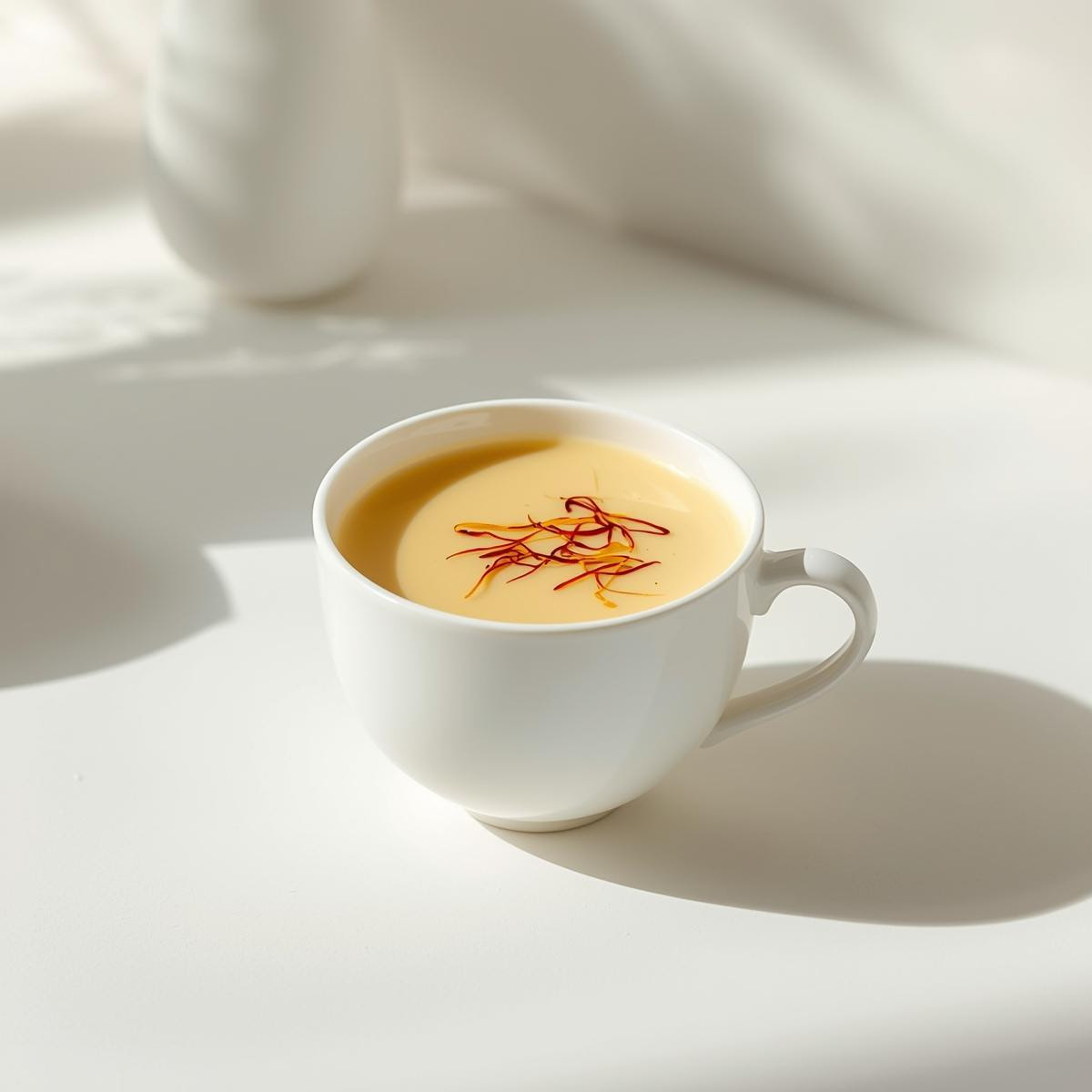
- Pour into your mug. Drink slowly, 30 to 45 minutes before you intend to sleep.
The Ingredients and the Science Behind Them
Saffron
Saffron's active compounds — safranal, crocin, and crocetin — have been studied in multiple randomised controlled trials for their effects on sleep quality, mood, and anxiety. In a 2021 meta-analysis published in Nutrients, saffron supplementation at doses of 14 to 30 mg per day significantly improved sleep quality scores compared to placebo. The proposed mechanism involves modulation of serotonin reuptake and GABA-A receptor activity — the same system disrupted by falling progesterone in perimenopause.
A dose of 4 to 6 threads is approximately 20 to 30 mg of saffron. This falls within the therapeutic range used in clinical studies.
In Ayurveda, saffron (kesar) is classified as a Medhya Rasayana — a nervine tonic that nourishes the mind. It is specifically indicated for Vata and Pitta imbalance, the doshic pattern associated with anxiety, insomnia, and internal heat. In TCM, saffron (zang hong hua) moves Blood, calms Shen (spirit), and clears Heart Heat — the pattern described as the cause of restlessness and night waking in perimenopause.
Cardamom
Cardamom is a warming aromatic that works through multiple mechanisms. Its volatile oils act on the gut-brain axis, supporting serotonin production in the enteric nervous system. It has mild antispasmodic effects, reducing the physical tension that often accompanies anxious sleep. Its warming quality also improves peripheral circulation, which supports the body's ability to dissipate heat through the skin — relevant for women whose night waking is accompanied by flushing or warmth without full hot flashes.
In Ayurveda, cardamom is a Tridoshic spice — it balances all three doshas. It is specifically indicated for Vata disturbances affecting the mind and nervous system. In TCM, it is used to move Qi, resolve dampness, and warm the Middle Jiao, supporting digestive and nervous system function.
Ashwagandha
Ashwagandha is an adaptogen — a plant compound that modulates the hypothalamic-pituitary-adrenal (HPA) axis, reducing cortisol output under chronic stress. In perimenopause, the HPA axis becomes hypersensitive as ovarian hormone production declines. The brain compensates by increasing GnRH and LH secretion, which dysregulates the entire stress axis. Elevated evening cortisol is a primary driver of sleep-onset difficulties and early morning waking in perimenopausal women.
A 2019 double-blind RCT in Medicine found that ashwagandha root extract (300 mg twice daily) significantly improved sleep quality, sleep onset latency, total sleep time, and sleep efficiency in adults with insomnia. A 2021 study in the Journal of Ethnopharmacology specifically examined perimenopausal women, finding improvements in sleep quality alongside reductions in anxiety and hot flash frequency.
In Ayurveda, ashwagandha is classified as a Vata-pacifying Rasayana — a rejuvenating tonic for the nervous system. Its Sanskrit name means "smell of horse" — a reference to the vigour and strength it imparts to those who use it consistently. In TCM, it has properties analogous to herbs that tonify Kidney Yang and Jing — the deep constitutional essence that perimenopause draws upon.
Cinnamon
Cinnamon stabilises blood glucose through its effects on insulin sensitivity. This is clinically relevant for perimenopausal sleep because nocturnal hypoglycaemia — a drop in blood sugar in the early hours — is a common cause of 2am waking that is frequently misattributed to anxiety or hot flashes. Cinnamon's warming aromatic quality also supports peripheral circulation and the body's heat dissipation mechanisms.
Black pepper
Piperine, the active compound in black pepper, inhibits the enzymes that metabolise many plant compounds before they reach the bloodstream. Adding a pinch of black pepper meaningfully increases the bioavailability of saffron's crocin and ashwagandha's withanolides. This is the same mechanism behind the traditional practice of combining black pepper with turmeric. A small pinch — less than 1/8 of a teaspoon — is sufficient.
Pairing Notes
This tonic works best as part of a consistent evening ritual. The ingredients require time to accumulate in the body — effects build over 7 to 14 days of regular use. It pairs well with:
- Cooling the room to 65 to 68 degrees Fahrenheit (18 to 20 degrees Celsius) before sleep. Core body temperature must drop for sleep onset to occur, and declining oestrogen impairs this mechanism.
- Avoiding screens for 30 minutes after drinking the tonic. Blue light suppresses melatonin production and counteracts the nervous system calming you are creating.
- A short body scan or Yoga Nidra practice while the tonic takes effect. The parasympathetic activation compounds the tonic's effects.
- Consistent timing. Drink it at the same time each evening. Circadian biology responds to consistency.
Ritual Guidance
In Ayurveda, the evening is governed by Kapha — the heavy, stable, cohesive energy that prepares the body for rest. The act of preparing a warm tonic is itself a signal to the nervous system that the day is complete. The warmth, the aroma, the deliberate pace of preparation all activate the parasympathetic nervous system before a single drop has been consumed.
This is not incidental. Ritual acts on the body through anticipatory physiology — the nervous system responds to cues, not just to biochemistry. A warm drink prepared and consumed with intention is neurologically different from the same drink consumed hastily while reading email.
Create a minimal container: the same mug, the same place, the same 10 minutes. The body learns from repetition.
Weekly Protocol
For best results, use this tonic consistently for at least four weeks before assessing its full effect:
- Week 1: Notice baseline. Observe your sleep without judgement. Keep a brief log if helpful — time to sleep, number of wakings, mood on waking.
- Weeks 2 and 3: Effects from ashwagandha's cortisol modulation typically begin in this window. Sleep onset may improve before sleep continuity does.
- Week 4 onwards: Saffron's serotonergic effects and ashwagandha's adaptogenic action are now established. Most women report the clearest improvements here.
If sleep disruption is severe or accompanied by significant anxiety, this tonic is a complementary support — not a replacement for clinical evaluation. Speak with your clinician about progesterone therapy, CBT-I (Cognitive Behavioural Therapy for Insomnia), or other interventions if symptoms are significantly affecting your quality of life.
Who Should Approach This Tonic with Caution
Ashwagandha is contraindicated in thyroid conditions (both hypo- and hyperthyroid), in pregnancy, and in autoimmune conditions. If you take thyroid medication or immunosuppressants, consult your clinician before using this tonic regularly.
Saffron at very high doses (above 5 g daily — far above what this recipe contains) has been associated with adverse effects. At the dose in this recipe (20 to 30 mg), it is considered safe for most healthy adults. Avoid in pregnancy.
Milk can be replaced with any plant milk for those with dairy intolerance. Oat milk is the closest in texture and does not significantly alter the tonic's function.
Frequently Asked Questions
Can I use plant milk instead of dairy?
Yes. Oat milk is the closest match in texture and mild sweetness. Almond milk works well. Coconut milk adds richness but can feel heavier before bed. All plant milks will carry the other ingredients effectively.
Can I prepare this in advance?
The tonic is best consumed fresh and warm. If necessary, you can prepare it up to 4 hours in advance and reheat gently — do not boil. Do not prepare large batches for storage.
How long before I notice a difference?
Most women notice improved sleep onset within 3 to 5 nights of consistent use. Full benefit from the adaptogenic and serotonergic effects typically builds over 2 to 4 weeks. Saffron's mood effects, if you are using it for that purpose, typically become noticeable after 6 to 8 weeks of daily use.
Can I use this if I am also taking HRT?
Yes, in most cases. This tonic is not known to interfere with standard HRT regimens. If you are on a specialised compounded protocol, check with your prescribing clinician.
I wake at 2am regardless of what I do. Will this help?
Early morning waking (2am to 4am) can have several causes in perimenopause: cortisol dysregulation, nocturnal hypoglycaemia, subclinical hot flashes, or anxiety. This tonic addresses cortisol dysregulation and blood glucose stability most directly. If early waking persists, a broader clinical evaluation is appropriate.
Is ashwagandha safe to use every night?
For most healthy women, yes. Traditional Ayurvedic use supports long-term daily supplementation. Many clinical trials have used daily doses for 8 to 12 weeks without adverse effects in healthy adults. It is reasonable to take a 1 to 2 week break every 3 months if using it continuously. Do not use if you have thyroid conditions or autoimmune disease without clinician guidance.
Sources
- Lopresti AL, Smith SJ. "Saffron supplementation in healthy adults: a systematic review of clinical studies." Nutrients. 2021. https://doi.org/10.3390/nu13020388
- Chandrasekhar K, Kapoor J, Anishetty S. "A prospective, randomized double-blind, placebo-controlled study of safety and efficacy of a high-concentration full-spectrum extract of ashwagandha root in reducing stress and anxiety in adults." Indian Journal of Psychological Medicine. 2012. https://doi.org/10.4103/0253-7176.106022
- Langade D, Kanchi S, Salve J, Debnath K, Ambegaokar D. "Efficacy and Safety of Ashwagandha Root Extract in Insomnia and Anxiety: A Double-blind, Randomized, Placebo-controlled Study." Medicine. 2019. https://doi.org/10.7759/cureus.5797
- Shim JS, Kim HG, Ju ES, Choi JG, Jeong HY, Lee HJ. "Effects of the aqueous extract of Withania somnifera on the female reproductive system and sleep quality in perimenopausal women." Journal of Ethnopharmacology. 2021. https://doi.org/10.1016/j.jep.2021.114016
- Khan A, Safdar M, Ali Khan MM, Khattak KN, Anderson RA. "Cinnamon improves glucose and lipids of people with type 2 diabetes." Diabetes Care. 2003. https://doi.org/10.2337/diacare.26.12.3215
- Kesarwani K, Gupta R, Mukherjee A. "Bioavailability Enhancers of Herbal Origin: An Overview." Asian Pacific Journal of Tropical Biomedicine. 2013. https://doi.org/10.1016/S2221-1691(13)60060-X
Second Spring Health exists to give women the information and support they deserve during the most underserved decade of their health. This tonic is one small piece of that.