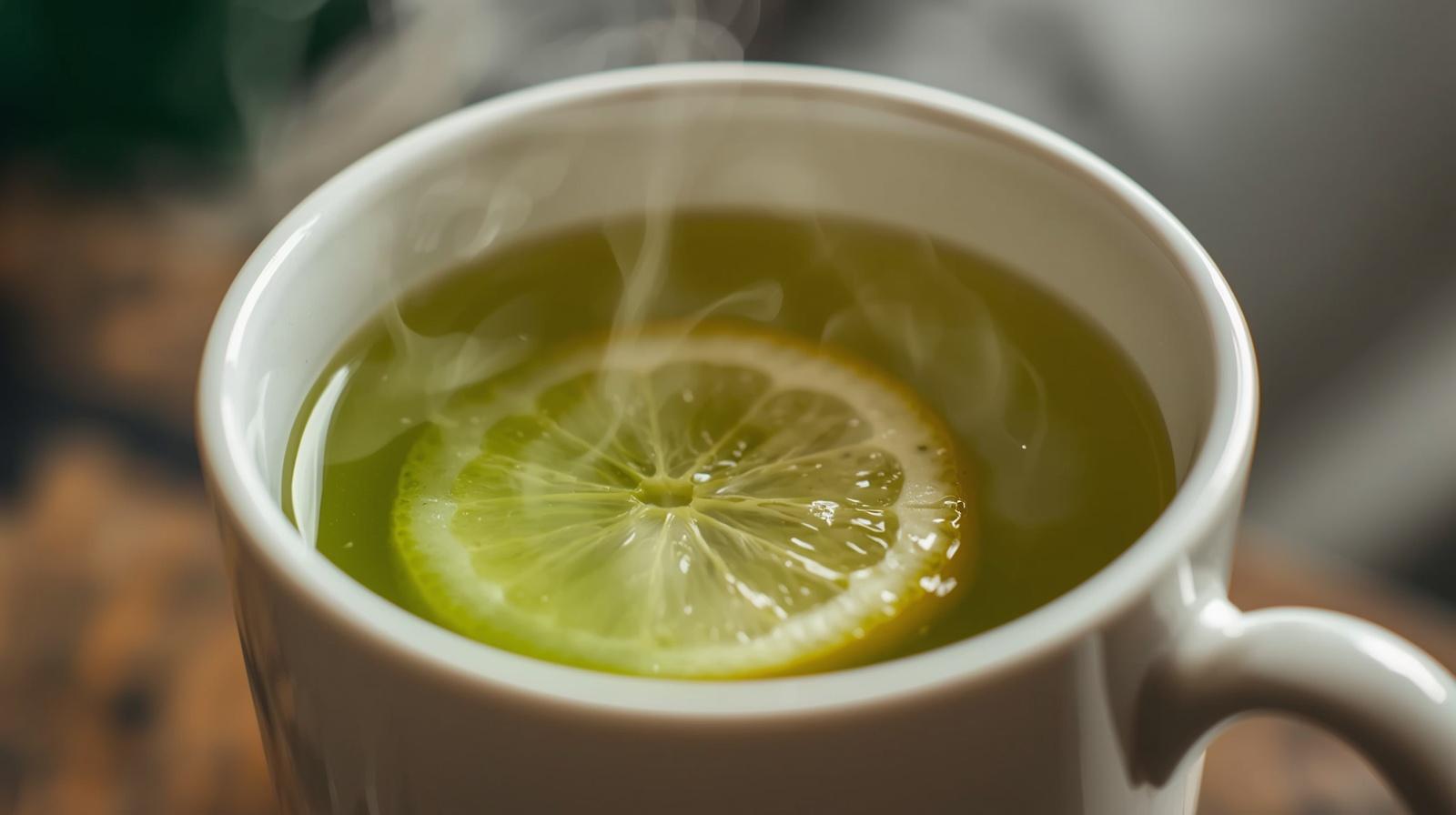
A daytime tea that sharpens the mind, protects the bones, and delivers more antioxidant power per cup than plain green tea, because lemon changes everything.
Prep time: 15 minutes | Daily serving: Throughout the day from one batch | Shelf life: 2 to 3 days at room temperature in summer; up to 1 week in winter
Water: 8 to 12 cups (1 to 1.5 liters, roughly one full kettle)
Dosha balance: Kapha and Pitta reducing; Vata balanced by cardamom
Best for: Brain fog, low energy, mood fluctuations, bone health, metabolism, weight management, antioxidant support, morning clarity
A note on caffeine
Green tea contains caffeine, generally between 20 and 45 mg per cup depending on the variety and brew time, compared to roughly 95 mg in a cup of coffee. For most women this is a manageable amount that provides gentle alertness without the cortisol spike of coffee.
However, caffeine is worth being thoughtful about during perimenopause for two reasons. First, it can aggravate hot flashes if consumed when you are already running hot. Second, it can disrupt sleep if taken too late in the day. The half-life of caffeine in the body is roughly 5 to 6 hours, meaning a cup at 3 pm may still be affecting your sleep at 9 pm.
Recommended timing: Drink this brew in the morning, ideally between waking and noon. It is an excellent first drink of the day, with or before breakfast. Do not drink it after 2 pm if you are sensitive to caffeine or if sleep disruption is one of your perimenopause symptoms.
If you are caffeine-sensitive: You can cold-brew this recipe. Slice the lemon and combine all ingredients in cold filtered water and refrigerate overnight. Cold brewing extracts significantly less caffeine from green tea while still releasing the L-theanine and a meaningful portion of the catechins. The flavor will be lighter and smoother.
Important: who should use caution
Iron absorption: Green tea tannins can inhibit non-heme iron absorption when taken with or immediately after iron-rich meals. If you are managing iron-deficiency anemia, drink this brew at least an hour away from iron-rich foods or iron supplements.
Thyroid medication: Green tea may reduce the absorption of levothyroxine (LT4). If you take thyroid medication in the morning, wait at least 30 to 60 minutes before drinking this brew.
Blood thinners: Green tea has mild anticoagulant properties. If you are on warfarin or other anticoagulants, check with your healthcare provider before making this a daily brew.
Pregnancy: Limit to one cup per day during pregnancy due to caffeine content. Consult your provider for personalized guidance.
What you need
- 2 tablespoons loose-leaf green tea (organic recommended)
- 1 teaspoon cardamom powder, or freshly ground cardamom with pods
- 1 large organic lemon, cut in half (goes into the pot with everything else)
- 8 to 12 cups filtered water (1 to 1.5 liters, one full kettle)
- Half-inch cube of fresh ginger, shredded (optional)
Everything goes into the pot together: tea, cardamom, lemon halves, and ginger if you are using it. Simmer, strain, and store. Boiling the lemon mellows its acidity and softens the bitterness of the peel, giving the brew a gentler, more rounded citrus flavor. For cold brew, slice the lemon and drop the slices directly into the cold water overnight. If you do not have a fresh lemon or prefer a brighter, sharper citrus note, squeeze fresh lemon juice or lime juice into the strained brew or into each cup individually.
When your body calls for this brew
- Brain fog or difficulty concentrating in the morning
- Low mood or flat energy on waking
- Weight gain around the midsection that is not responding to diet
- Joint stiffness or inflammatory discomfort
- Wanting to support bone density proactively
- Needing a calm, sustained alertness without the cortisol spike of coffee
- Digestive sluggishness or bloating after meals
- Skin that is losing elasticity or luminosity
About this recipe
This is a daytime formula built on a scientifically important pairing: green tea and lemon. Most people add lemon to tea for flavor. What the research shows is that lemon juice is actually a co-factor that dramatically increases the amount of EGCG your body absorbs from the green tea. Without it, less than 20 percent of green tea's catechins survive digestion. With lemon juice, 80 percent remain stable through the digestive process. You are not changing the flavor. You are multiplying the benefit.
Cardamom is the balancing element. In Ayurveda and TCM, green tea is cooling and slightly drying, which means it can aggravate Vata-dominant women who are already dealing with the dryness, anxiety, and erratic quality of hormonal transition. Cardamom governs this: it is warming to the extremities and digestive system, grounding to the nervous system, and a classical carrier herb that helps other botanicals absorb more fully. Fresh ginger, if you include it, extends the warmth further and adds its own anti-inflammatory layer through gingerols, compounds that work through different pathways than EGCG, making them additive rather than redundant.
The result is a brew that gives you the cognitive and cardiovascular benefits of green tea, the bone-protective and antioxidant power of EGCG, the L-theanine calm that distinguishes green tea from coffee, and the warming digestive support of cardamom and ginger. All from a pot that lasts you most of the week.
Why this recipe supports you
- Supports bone density, which begins declining in perimenopause
- Delivers L-theanine for calm, sustained focus without cortisol spikes
- Reduces brain fog through EGCG's neuroprotective and anti-inflammatory action
- Lemon multiplies EGCG absorption from less than 20 percent to 80 percent
- Supports metabolism and healthy weight distribution during hormonal shift
- Reduces LDL cholesterol and diastolic blood pressure (cardiovascular support)
- Cardamom balances green tea's Vata-aggravating tendency
- Ginger provides anti-inflammatory gingerols that complement EGCG
- Lemon Vitamin C supports adrenal function and collagen production
- Supports liver detoxification of estrogen metabolites
Why these ingredients work together
This recipe is built around one central idea: green tea is more powerful when it has the right companions. On its own, green tea loses most of its active compounds before they can be absorbed. Each ingredient in this formula has a specific job in making the whole greater than the sum of its parts.
Lemon does not just brighten the flavor. Its Vitamin C creates an acidic environment in the digestive tract that stabilizes the catechins in green tea, preventing their degradation before absorption. Research from Purdue University found that lemon juice caused 80 percent of green tea's catechins to remain stable after simulated digestion, compared to less than 20 percent in plain green tea.
Cardamom governs the energetics of the formula in the Ayurvedic sense. Green tea is cooling, bitter, and slightly drying. These qualities are appropriate for Pitta and Kapha women but can, over months of daily use, aggravate Vata by increasing dryness, digestive irregularity, and nervous system instability. These are precisely the patterns that perimenopause is already amplifying in many women. Cardamom is the classical governing herb: it introduces warmth to the digestive channel, moisture through its slightly oily quality, and sweetness that counterbalances the bitterness.
Fresh ginger, when included, extends the warming and anti-inflammatory action further. Gingerols in fresh ginger work through different anti-inflammatory pathways than EGCG, meaning they are additive rather than redundant. Ginger also improves gastric emptying, supporting the absorption of everything else in the brew.
Ingredients and their wisdom
Loose-leaf green tea (2 tablespoons)
Thermal quality: Cooling. The cognitive, cardiovascular, and bone-protective foundation of this brew.
Ayurveda: Quality: Cooling (Shita), Light (Laghu), Dry (Ruksha), Mobile (Chala). Dosha effect: Reduces Pitta and Kapha; can increase Vata in excess or without warming companions. Taste (Rasa): Bitter, Astringent.
In Ayurveda, green tea is considered a bitter and astringent herb, both tastes associated with purification, cooling, and the reduction of excess heat and accumulation. Its bitter rasa clears ama (undigested toxins) from the channels, supports liver function, and reduces Pitta in the blood, all relevant actions during perimenopause when the liver must take over increasing responsibility for hormone metabolism.
TCM: Nature: Cool. Meridian: Heart, Lung, Stomach. Action: Clears Heat, disperses accumulation, supports Liver Qi, calms the Shen, promotes fluid metabolism.
In TCM, green tea (Lu Cha) is used to clear summer heat, support alertness, and promote the movement of fluids. Its effect on the Liver is relevant for perimenopause: the Liver governs the smooth flow of Qi and Blood, and when Liver Qi stagnates, the symptoms are exactly what many perimenopausal women describe: irritability, headaches, tight chest, fluctuating emotions, and difficulty with transitions.
Nutrition: Key nutrients: EGCG (epigallocatechin gallate), L-theanine, caffeine, quercetin, Vitamin B2, Vitamin B3, manganese, potassium.
EGCG is the most studied polyphenol in green tea and one of the most researched botanical compounds in the world. A 2021 study found that women who drank tea regularly before menopause had significantly improved bone mineral density compared to non-drinkers, with the benefit being greater in those who drank more than four times per week. EGCG inhibits osteoclast activity (the cells that break down bone) while supporting osteoblast function (the cells that build it). L-theanine promotes alpha-wave brain activity, the state associated with relaxed alertness, and when combined with caffeine in the ratio present in green tea, improves cognitive performance without the jitteriness or cortisol-spiking that coffee produces.
Organic lemon, cut in half (1 large)
Thermal quality: Cooling to neutral. The bioavailability co-factor that makes this formula work at full strength.
Ayurveda: Quality: Light (Laghu), Mobile (Chala), Sharp (Tikshna). Dosha effect: Stimulates Pitta and digestive fire in small amounts; reduces Kapha accumulation; sour taste supports Vata. Taste (Rasa): Sour (Amla), secondarily Pungent.
Lemon (Nimbu) is one of Ayurveda's most important Agni-stimulating foods. The sour rasa directly kindles digestive fire, improves the absorption of other foods and herbs taken alongside it, and supports liver function. In classical Ayurvedic practice, warm water with lemon first thing in the morning is one of the most widely recommended daily rituals precisely because it awakens digestive function and begins the day's detoxification processes.
TCM: Nature: Cool. Meridian: Stomach, Liver. Action: Generates fluids, harmonizes the stomach, supports Liver function, clears Summer Heat.
In TCM, lemon belongs to the sour flavor category, which has an astringent and gathering action on the Liver. Sour flavors enter the Liver channel and help consolidate and nourish Liver Yin, the cooling, fluid aspect of Liver function that often becomes depleted in perimenopausal women with Liver Yang rising symptoms: irritability, headaches, flushed face, heat rising to the chest and head.
Nutrition: Key nutrients: Vitamin C (approximately 30 to 50 mg per half lemon), citric acid, flavonoids (hesperidin, eriocitrin), limonene, potassium.
A study published in Molecular Nutrition and Food Research found that adding lemon juice to green tea caused 80 percent of the tea's catechins to remain stable after simulated digestion, compared to less than 20 percent in plain green tea. Citrus juice produced the highest catechin recovery of any additive tested. This catechin-stabilizing action is present whether you simmer the lemon in the pot or squeeze fresh juice in afterward; both methods protect the EGCG.
Cardamom powder (1 teaspoon, freshly ground with pods)
Thermal quality: Warming to the digestive system, cooling to excess Pitta heat. The balancing governor of this formula.
Ayurveda: Quality: Cooling to the gut (Shita virya), light, slightly oily. Dosha effect: Tridoshic in this context; specifically counterbalances green tea's Vata-aggravating quality. Taste (Rasa): Sweet, Pungent.
Cardamom (Ela) plays the same governing role in this formula as it plays in the saffron tonic: it is the balancing Anupana that makes daily consumption of an otherwise constitutionally challenging herb safe for all body types. Green tea's bitter, drying, cooling nature can, over time, aggravate Vata: increasing dryness, digestive irregularity, anxiety, and the cold, erratic quality that Vata-dominant perimenopausal women are already managing. Cardamom's sweet rasa counterbalances the bitterness. Its gentle warming action counterbalances the cooling. Its oily quality counterbalances the dryness. Grinding cardamom with its pods rather than using pre-ground powder is the Ayurvedic recommendation: the pods contain essential oils that pre-ground powder has lost.
TCM: Nature: Warm. Meridian: Spleen, Stomach, Lung. Action: Transforms dampness, moves Qi, settles the Stomach, supports the descent of rebellious Qi.
In TCM, cardamom resolves Dampness in the middle Jiao. During perimenopause, many women accumulate Dampness as Spleen Qi weakens under the demands of hormonal transition, stress, and age. Dampness manifests as the heaviness, foggy thinking, bloating, fatigue, and the tendency toward weight gain that does not fully respond to dietary changes. Cardamom warms the Spleen, supports its transforming and transporting function, and ensures that the nutrients from the brew are properly metabolized and distributed.
Nutrition: Key nutrients: Cineole (1,8-cineole), alpha-terpineol, terpinen-4-ol, manganese, antioxidant polyphenols.
Cardamom's cineole content has documented effects on cortisol reduction and parasympathetic nervous system activation, making it a genuine biochemical complement to L-theanine rather than simply a flavor addition. L-theanine calms the central nervous system through GABA modulation. Cineole reduces cortisol at the adrenal level. Both actions are needed for the perimenopausal woman whose HPA axis is under sustained stress. Freshly grinding the cardamom with its pods preserves more of the volatile oils that carry these benefits.
Fresh ginger, shredded (optional, roughly half-inch cube)
Thermal quality: Warming. An optional amplifier that extends the anti-inflammatory and digestive benefit of the formula.
Ayurveda: Quality: Warming (Ushna), Penetrating (Tikshna), Light (Laghu). Dosha effect: Reduces Vata and Kapha strongly; use in moderation for Pitta. Taste (Rasa): Pungent.
Fresh ginger (Ardraka) is one of Ayurveda's most important digestive and anti-inflammatory herbs. In the context of this formula, it extends the warming counterbalance that cardamom provides against green tea's cooling nature. If you are a Vata-dominant woman or one who runs cold generally, adding ginger makes this formula more grounding and deeply nourishing. If you are a Pitta-dominant woman who already runs hot, cardamom alone is sufficient and ginger may not be necessary.
TCM: Nature: Warm to slightly hot. Meridian: Lung, Spleen, Stomach. Action: Warms the middle, disperses cold, moves Qi, reduces nausea, supports Wei Qi (defensive energy).
Fresh ginger (Sheng Jiang) warms the middle Jiao, disperses cold in the Stomach and Spleen, and supports the Wei Qi that protects the body from external pathogens. The pairing of ginger and cardamom creates what TCM calls a warming, moving combination: both herbs warm the middle, both move Qi, and together they ensure the full activation of digestive and absorptive function.
Nutrition: Key nutrients: Gingerols, shogaols, paradols, zingerone, potassium, Vitamin C, Vitamin B6.
Gingerols, the primary active compounds in fresh ginger, are potent anti-inflammatories that work through COX-2 inhibition, the same pathway targeted by ibuprofen, but without the gastric side effects. This action is additive with EGCG's anti-inflammatory action through NF-kB inhibition, meaning the two compounds reduce inflammation through different and complementary pathways. For perimenopausal women dealing with joint pain, this combination provides meaningful relief through daily use.
Why these pairings work
Green tea and Lemon (The bioavailability transformation): EGCG, the primary active compound in green tea, is unstable in the non-acidic environment of the small intestines. Without any intervention, less than 20 percent of the catechins in green tea survive the digestive process to reach the bloodstream. Lemon juice creates an acidic environment that stabilizes these catechins through digestion. Research from Purdue University found that lemon juice caused 80 percent of tea's catechins to remain after simulated digestion. This is not a flavor pairing. It is a pharmacokinetic relationship.
Green tea and Cardamom (Governing the cooling quality): Green tea is cooling, bitter, and drying in Ayurveda. These qualities are beneficial for Pitta and Kapha constitutions but can, over months of daily use, aggravate Vata. Cardamom is the classical governing herb: it introduces warmth to the digestive channel, moisture through its slightly oily quality, and sweetness that counterbalances the bitterness. This is the principle of Anupana applied to a daily brew: not just combining flavors but using one ingredient to make another safe for sustained use across all constitutions.
Green tea and Ginger (Warming the cooling, amplifying the anti-inflammatory): In TCM, green tea and ginger represent the principle of using a warming herb to make a cooling herb accessible to cold constitutions. Nutritionally, gingerols and EGCG work through different anti-inflammatory pathways, making them genuinely additive. One cup of this brew when ginger is included provides simultaneous COX-2 inhibition (ginger) and NF-kB inhibition (EGCG), two of the primary inflammatory pathways involved in perimenopause symptoms from joint pain to mood disruption.
Cardamom and Lemon (Agni activation and absorption): Both cardamom and lemon kindle Agni, the digestive fire, through different mechanisms. Lemon's sour rasa stimulates the secretion of digestive enzymes and bile. Cardamom's aromatic volatile oils warm and move the digestive channel. Together they create the optimal conditions for absorbing everything that the green tea contributes.
How to make it
Step 1: Combine and simmer
Add to a pot or kettle: 2 tablespoons loose-leaf green tea, 1 teaspoon cardamom powder (or freshly ground cardamom with pods), the lemon halves, and the shredded fresh ginger if you are including it. Cover with 8 to 12 cups of filtered water. Bring to a gentle simmer and hold there for 10 to 15 minutes. The lemon simmers with everything from the start. This is intentional: simmering the whole lemon reduces the sharpness of the citric acid and mellows the bitterness of the peel, producing a gentler, more rounded citrus note. The peel also releases its limonene, hesperidin, and essential oils into the brew during the simmer, compounds that you would not get from simply squeezing juice in afterward.
Step 2: Strain and store
After simmering, remove from heat and let steep for a further 5 to 10 minutes. Then strain out all solids: the tea leaves, cardamom, ginger, and lemon halves. Pour the strained brew into a glass jar or kettle for storage.
If you do not have a fresh lemon, or if you prefer a brighter, sharper citrus flavor rather than the mellow simmered version, simply leave the lemon out of the pot and add fresh lemon juice or lime juice to each cup individually when you pour it. Simmered lemon gives a gentler, rounded citrus note. Fresh juice added afterward gives more brightness and sharpness.
Step 3: Drink throughout the day
This brew keeps at room temperature for 2 to 3 days in warm weather and up to a week in cooler months. You can drink it warm, at room temperature, or cold depending on your constitution and the season. Pitta-dominant women often prefer it at room temperature or slightly cool. Vata-dominant women should drink it warm, especially in the morning. Reheat gently without bringing to a full boil.
A note on water temperature for brewing: Traditionally, high-quality green tea is brewed at around 70 to 80 degrees Celsius (160 to 175 degrees Fahrenheit) rather than boiling water, because boiling can make the catechins bitter and degrade some of the more delicate compounds. A gentle simmer rather than a rolling boil achieves this.
When, how much, and how to receive it
Ideal timing: Morning, between waking and noon. First drink of the day or alongside breakfast. This brew is best as a morning and midday companion. It provides the cognitive clarity, gentle energy, and anti-inflammatory support that makes the active hours of the day more productive and less symptomatic. Do not drink after 2 pm if you are sensitive to caffeine or if sleep disruption is among your perimenopause symptoms.
How much: One batch (8 to 12 cups) provides enough tea for 2 to 3 days or up to a week depending on the season. Drink as much as you like during the morning and midday hours. The research on green tea's cardiovascular and bone benefits references 2 to 4 cups per day as the range associated with measurable benefit. Do not exceed 4 to 5 cups per day if you are sensitive to caffeine, or if you are managing iron deficiency.
Vessel: A ceramic or glass pot is ideal. Use organic loose-leaf green tea whenever possible. Commercial tea bags often contain lower-quality fannings with reduced catechin content. Freshly grinding cardamom with its pods releases significantly more volatile oils than pre-ground powder.
What to avoid alongside this brew
- Iron supplements or iron-rich meals within 30 to 60 minutes of drinking (tannin inhibition of iron absorption)
- Thyroid medication within 30 to 60 minutes if you take levothyroxine in the morning
- Drinking after 2 pm if you are sleep-sensitive
- Adding milk, which binds to catechins and reduces their bioavailability
- Sweetening with large amounts of sugar, which competes with the metabolic benefits
What to pair this morning ritual with
- 10 to 20 minutes of movement before or after: walking, yoga, or stretching
- Avoiding screens for the first 15 to 20 minutes while you drink it
- A protein-containing breakfast, which supports sustained energy alongside the L-theanine
- Brief journaling or setting an intention for the day: the calm alertness of L-theanine makes this a particularly receptive time for reflection
How to use this over time
This is a daily daytime companion, not a short-term protocol. The bone-protective effects of green tea are documented in women who drank tea regularly before menopause, meaning the benefit accumulates over time.
Week 1: Notice the quality of your mornings. Brain fog, mood on waking, energy through the midday hours, joint stiffness.
Month 1: Most women report clearer cognitive function and improved morning energy. Hot flash frequency may begin to improve as the anti-inflammatory and hormone-regulating effects accumulate.
Ongoing: The bone-protective and cardiovascular benefits are long-term investments. This is one of the most evidence-backed things a perimenopausal woman can do daily for her long-term health, alongside sleep, movement, and stress management.
Notice what shifts over the first few weeks: morning energy and mental clarity, hot flash frequency and intensity, joint comfort and stiffness on waking, mood and emotional resilience, weight distribution and digestive ease, skin quality and luminosity.
Common questions
Does simmering green tea destroy its benefits? Gentle simmering at around 70 to 80 degrees Celsius is within the acceptable range for green tea preparation and does not destroy the primary catechins or L-theanine. Prolonged hard boiling can degrade some compounds and increase bitterness. The method in this recipe, a gentle simmer rather than a rolling boil, is designed to extract the active compounds without destroying them.
Can I add honey to this brew? Yes. Raw honey added after the brew has cooled to drinking temperature is the best choice. Avoid adding honey while the brew is still hot, as heating honey above body temperature degrades its enzymes. Allulose is another option with no glycemic impact. Avoid cane sugar, which undermines the metabolic and blood sugar benefits of the formula.
What type of green tea works best? Any high-quality loose-leaf green tea works well. Japanese varieties such as sencha and gyokuro tend to have higher L-theanine content. Chinese varieties such as Dragon Well (Long Jing) and Bi Luo Chun are excellent for their EGCG content. Matcha powder can also be used: whisk a teaspoon of matcha into the warm brew after straining for a significantly more concentrated version.
I run very hot. Is the ginger going to aggravate my hot flashes? This depends on your constitution and the amount. Fresh ginger in small quantities (a half-inch cube shredded into a large batch of 8 to 12 cups) is diluted enough that most Pitta-dominant women tolerate it well. If you are experiencing very frequent hot flashes, omit the ginger initially and add it after a few weeks once the green tea and cardamom have had time to cool your system.
Can I drink this alongside the Hibiscus and Hawthorn tea? Yes, but not at the same time of day. The Hibiscus and Hawthorn tea is a daytime cardiovascular tonic that contains no caffeine and is most effective spread through the morning and midday hours. The practical solution is to alternate: drink the hibiscus tea one morning, the green tea brew the next, or split them with hibiscus in the early morning and green tea midmorning. Do not combine them in the same cup.
Sources and references
Ferruzzi MG et al. Common tea formulations modulate in vitro digestive recovery of green tea catechins. Molecular Nutrition and Food Research. 2008. doi:10.1002/mnfr.200700146
Mancini E et al. Green tea effects on cognition, mood, and human brain function: a systematic review. Phytomedicine. 2017. doi:10.1016/j.phymed.2017.07.008
Rondanelli M et al. A 60-day green tea extract supplementation counteracts the dysfunction of adipose tissue in overweight post-menopausal women. Nutrients. 2022. doi:10.3390/nu14245209
Lee DB et al. Relationship between regular green tea intake and osteoporosis in Korean postmenopausal women: a nationwide study. Nutrients. 2021.
Ni S et al. A meta-analysis of tea consumption and risk of coronary artery disease. European Journal of Nutrition. 2017. doi:10.1007/s00394-015-1030-8
Frawley D, Lad V. The Yoga of Herbs: An Ayurvedic Guide to Herbal Medicine. Lotus Press. 1986.
Maciocia G. The Practice of Chinese Medicine. Churchill Livingstone. 2008.