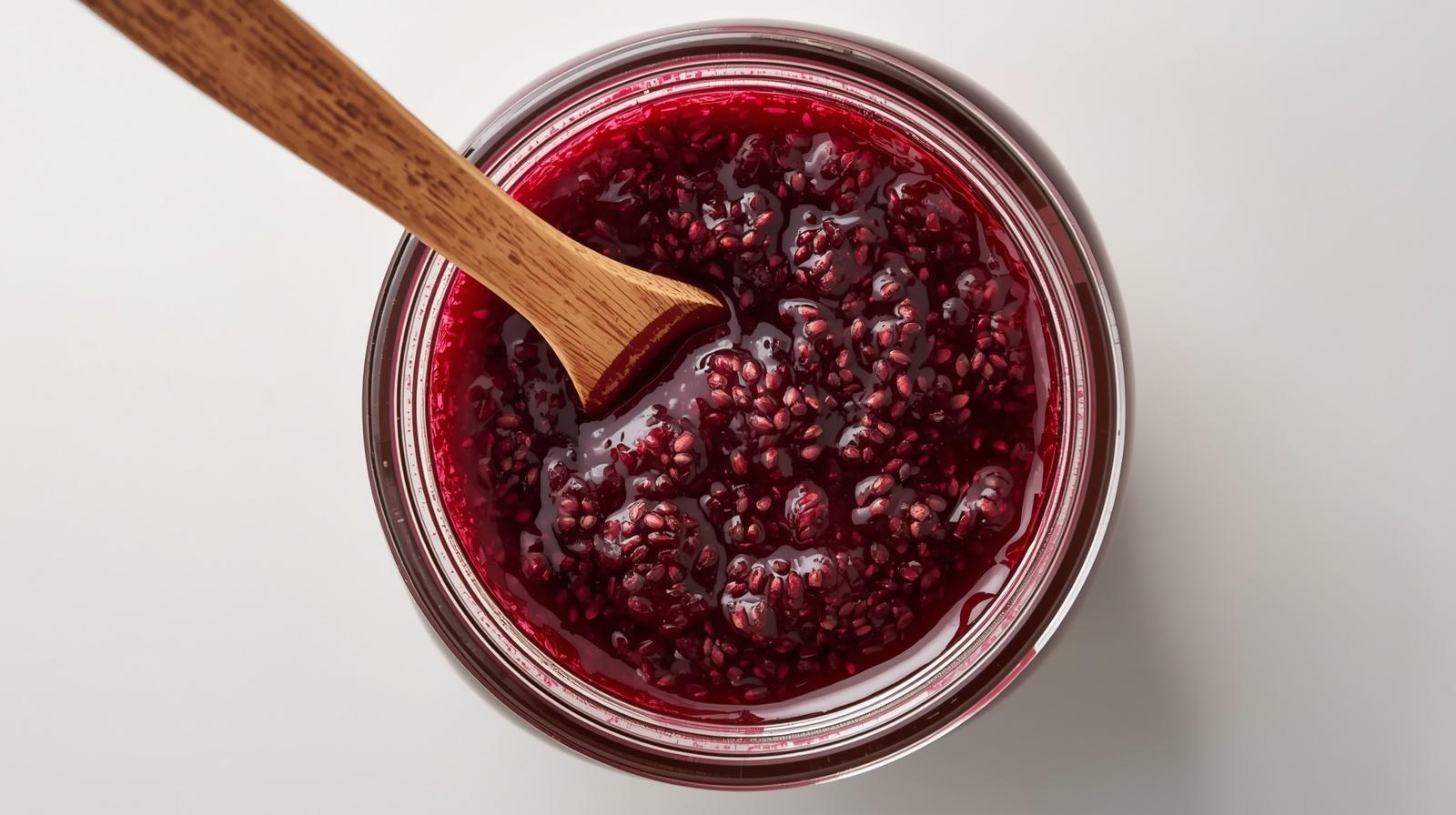
Shared by Neepa Dholakia. Four ingredients, five minutes, and a fiber-rich, antioxidant-dense topping that sets itself in the refrigerator. Adjust the sweetener to your taste.
Approximately 300g
A few days refrigerated
5 minutes, plus 30 minutes setting
Gut health, antioxidant support, hormone balance, blood sugar stability; a topping for oatmeal, porridge, or the ragi crackers from this collection
A note about Neepa Dholakia
Neepa Dholakia is a scholar in bioinformatics and computational biology who contributed to peer-reviewed research on liver expression quantitative trait loci at the Institute for Pharmacogenomics and Individualized Therapy at the University of North Carolina at Chapel Hill, published in Frontiers in Genetics. She is deeply caring, very helpful to her neighbors, and an active presence in her local community. She is also an advocate for mental health and supports people navigating illness and recovery with generosity and attention.
She makes this jam regularly, with raspberries as at least half the berry weight because raspberries have the most fiber. That specificity is the mark of someone who pays attention.
What you need
- --300g mixed berries, at least 150g of which should be raspberries (for fiber content)
- --1 tablespoon maple syrup, or sweetener of your choice to taste
- --1 tablespoon chia seeds
- --A pinch of pink Himalayan salt (optional but recommended: it adds trace minerals that support cellular hydration and electrolyte balance)
How to make it
- 1Place the berries in a microwave-safe bowl. Microwave for 1 minute.
- 2Mash slightly. You want texture, not a smooth puree.
- 3Add the maple syrup, chia seeds, and salt if using. Mix together, mashing a little more as you go.
- 4Let it sit in the refrigerator for at least 30 minutes. The chia seeds will absorb the berry liquid and the mixture will thicken into a jam-like consistency.
- 5Eat as a topping, stir it in, or eat it by itself.
Adjusting thickness
One tablespoon of chia seeds produces a soft, spoonable jam. For a thicker consistency closer to a traditional spread, add an extra half tablespoon of chia seeds and allow a longer setting time. The chia seeds continue to absorb liquid over the first day so the jam firms further overnight.
No microwave?
Warm the berries in a small saucepan over low heat for 3 to 4 minutes until they soften and release their juices. The result is the same.
The raspberry rule
Raspberries have significantly more fiber than other berries. At least 150g of the 300g should be raspberries. The rest can be blueberries, strawberries, blackberries, or any combination. Each brings its own antioxidant profile.
About this recipe
This is not a jam in the traditional sense. There is no pectin, no sugar syrup, no long cooking. It is berries warmed just enough to soften, mashed slightly to keep texture, and thickened by chia seeds as they absorb the liquid and expand. The result is something between a compote and a jam, with the full nutrient profile of fresh berries preserved because nothing has been cooked long enough to destroy it.
What makes this particularly smart for perimenopausal women is the combination of the two main ingredients. Berries, particularly raspberries and blueberries, are among the most concentrated sources of polyphenols available. These compounds reduce systemic inflammation, support estrogen metabolism in the liver, protect brain function, and provide antioxidant protection against the oxidative stress that perimenopause amplifies. Chia seeds provide omega-3 fatty acids, soluble fiber, and lignans that gut bacteria convert to phytoestrogenic compounds, offering gentle hormonal support alongside their structural role as the thickener.
Why this recipe supports you
- ◆Raspberries provide the highest fiber content of common berries, directly supporting gut microbiome diversity and regular elimination
- ◆Berry anthocyanins reduce systemic inflammation through multiple pathways relevant to perimenopause symptom severity
- ◆Blueberry pterostilbene and resveratrol support cognitive function and neurological protection as estrogen's neuroprotective role diminishes
- ◆Berry polyphenols support liver detoxification of estrogen metabolites, addressing one of the root mechanisms of estrogen dominance in perimenopause
- ◆Chia seed omega-3 ALA reduces vasomotor symptom frequency when consumed regularly
- ◆Chia soluble fiber slows glucose absorption, supporting the blood sugar stability that deteriorates during perimenopause
- ◆Chia lignans are converted by gut bacteria to phytoestrogenic compounds, providing gentle hormonal support
- ◆Maple syrup as sweetener provides trace manganese and zinc alongside its sweetness, unlike refined sugar
- ◆The no-cook preparation preserves heat-sensitive Vitamin C and polyphenols that long cooking would degrade
Ingredients and their wisdom
Berries, 300g (at least 150g raspberries)
Thermal quality: Cooling. The antioxidant and fiber foundation.
Ayurveda
Berries are classified in Ayurveda as cooling, Pitta-reducing, and Rakta Shodhaka (blood purifying). Their sweet and slightly sour tastes kindle gentle digestive fire without overheating. They are among the most appropriate foods for the Pitta-dominant heat conditions of perimenopause: hot flashes, skin inflammation, irritability, and the internal heat that accompanies hormonal fluctuation.
Nutrition
Raspberries contain approximately 6.5g of fiber per 100g, the highest of common berries. Blueberries contain pterostilbene and anthocyanins with documented neuroprotective effects. Strawberries are high in Vitamin C. Blackberries provide ellagic acid with liver-supporting properties. All berries contain anthocyanins, the polyphenols responsible for their deep color and for their well-researched anti-inflammatory effects. These compounds inhibit NF-kB inflammatory signaling and support healthy estrogen metabolism in the liver.
Chia seeds (1 tablespoon)
Thermal quality: Cooling to neutral. The fiber, omega-3, and thickening agent.
Nutrition
One tablespoon of chia seeds provides approximately 2.5g of omega-3 ALA, 3g of fiber, 2g of protein, and meaningful amounts of calcium, magnesium, and phosphorus. The omega-3 content is directly relevant: research has found that omega-3 supplementation at consistent doses can reduce vasomotor symptom frequency, including hot flashes and night sweats, over 8 to 12 weeks of use. The soluble fiber in chia seeds forms a gel when wet, which is what thickens this jam. That same gel slows gastric emptying and glucose absorption, providing blood sugar stability. Chia lignans are converted by gut bacteria to enterolactone, a phytoestrogenic compound.
Maple syrup (1 tablespoon, or to taste)
A natural sweetener that provides more than sugar.
Nutrition
Maple syrup contains manganese, zinc, and over 24 antioxidant compounds not present in refined sugar or corn syrup. Research has identified anti-inflammatory polyphenols in maple syrup, including quebecol, a compound unique to maple. Its glycemic index is lower than white sugar, and in the small amount used here, it contributes sweetness without significantly disrupting blood sugar. Other sweeteners work equally well: honey, coconut sugar, date syrup, or none at all if the berries are sufficiently sweet.
How to use it
- ◆Spooned over oatmeal or porridge, particularly good with ragi porridge given the complementary mineral profiles
- ◆Spooned over the Ragi, Sesame, and Flax Crackers from this collection for a complete snack that combines berry antioxidants with sesame calcium and lignans
- ◆Eaten straight from the jar by the spoonful. A few days in the refrigerator and it is just as good.
- ◆Spread on toast or flatbread as you would any jam
Sources and references
Basu A et al. Blueberries decrease cardiovascular risk factors in obese men and women with metabolic syndrome. Journal of Nutrition. 2010.
Iqbal A et al. Effects of omega-3 polyunsaturated fatty acids intake on vasomotor symptoms, sleep quality and depression in postmenopausal women: a systematic review. Nutrients. 2023.
Parikh M et al. Dietary flaxseed as a strategy for improving human health. Nutrients. 2019. (Chia and flax lignan conversion to phytoestrogenic compounds.)
Dholakia N, Glubb DM, Innocenti F. Liver expression quantitative trait loci: a foundation for pharmacogenomic research. Frontiers in Genetics. 2012.
Bloom in the pause.