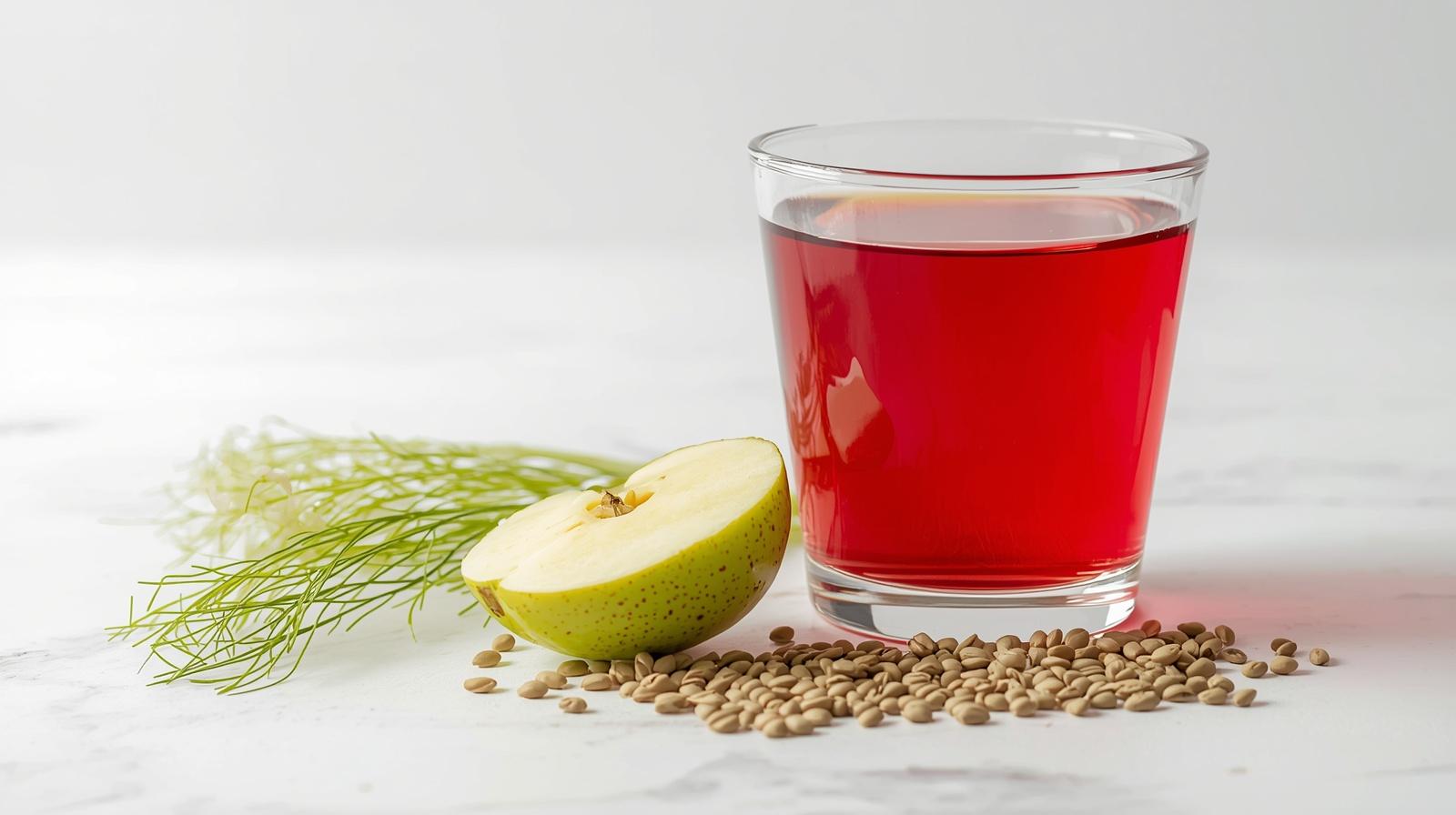
A sweet, cold, and deeply cooling summer drink made by soaking goji berries and fennel seeds, then blending with green apple and water. Something you genuinely want to drink after a walk or a workout, that also happens to be one of the most nourishing things you can give your body during perimenopause.
6 to 8 cups
Up to one week refrigerated
Morning through early evening
Hot flash relief, hormone balance, digestive support, post-workout cooling, summer hydration
What you need
- --A good handful of goji berries, soaked 4 to 8 hours or overnight
- --1/2 cup fennel seeds (variyali, sauf), soaked for a couple of hours
- --1 green apple, unpeeled, cut into pieces
- --6 to 8 cups of water (including soaking water)
- --If no green apple: one regular apple plus a squeeze of fresh lemon or lime juice on top
Soaking the goji berries
Soak in water for 4 to 8 hours or overnight. Room temperature or refrigerator, either works. The soaking plumps the berries and begins releasing their active compounds into the water. Use both the berries and their soaking water in the blend.
Soaking the fennel seeds
Soak for a couple of hours in water. This softens the seeds and begins releasing anethole, the primary active compound, into the liquid. A couple of hours is enough. Use both the seeds and their soaking water in the blend.
How to make it
- 1Soak the goji berries 4 to 8 hours ahead, or overnight. Soak the fennel seeds for a couple of hours ahead.
- 2Add the apple pieces to the blender first.
- 3Add the soaked fennel seeds with their soaking water.
- 4Add the soaked goji berries with their soaking water.
- 5Add the remaining water, 6 to 8 cups total including the soaking water.
- 6Blend until smooth. Taste and adjust water to your preferred consistency.
- 7Refrigerate. Serve cold, straight from the fridge.
No Vitamix?
Any high-powered blender works. Start with the apple pieces first so the blade catches the softer ingredients more easily. Blend in batches if needed.
Green apple versus regular apple
Green apple is ideal because its tartness balances the sweetness of the goji berries and keeps the drink refreshing rather than sweet. If using a regular apple, a squeeze of lemon or lime on top brightens the flavor and adds Vitamin C. Both versions work well.
When to drink it
This is a morning through early evening drink. In summer it is exactly what you want after a walk, a workout, or any time you come home thirsty for something sweet and cold but want to be drinking something genuinely nourishing. It is refreshing, lightly sweet, and satisfying in the way that only real food can be.
From an Ayurvedic perspective, fruit is best taken when digestive fire (agni) is active and strong, during the morning and midday. By evening, agni naturally begins to settle. Allow some space between this drink and the evening meal, and avoid it immediately before bed. Through the morning and into the early afternoon it is entirely appropriate, and particularly welcome on hot days or after physical activity when the body is calling for something cooling and replenishing.
Ayurveda and TCM verdict
This combination is well-suited to perimenopause from both an Ayurvedic and TCM perspective, and the verdict is a clear yes.
Ayurvedic tradition classifies all three main ingredients as cooling and appropriate for Pitta-dominant conditions. Fennel seeds (Shatapushpa) are specifically indicated for Rajonivrutti (menopause) because of their cooling, Vata-reducing, and phytoestrogenic properties. Goji berries are Rasayana (rejuvenating), nourishing to the deeper tissues, and supportive of Ojas. Green apple is tridoshic and gently cooling, brightening the flavor while providing pectin for gut microbiome support.
In TCM, goji berries (Gou Qi Zi) are one of the most important Kidney and Liver Yin tonic herbs in the classical materia medica. Kidney Yin deficiency is the primary TCM pattern underlying perimenopause: the internal heat, night sweats, hot flashes, dryness, disturbed sleep, and restlessness all correspond to depleted Yin unable to anchor Yang. Goji berries directly address this root cause. Fennel (Xiao Hui Xiang) moves Liver Qi stagnation, addressing the bloating, irritability, and digestive cramping that often accompany the transition.
Why this drink supports you
- ◆Fennel anethole acts on estrogen receptors, with clinical trials showing reduced hot flash frequency and severity in menopausal women
- ◆Fennel reduces Vata and cools Pitta, the two dosha patterns most disrupted during perimenopause
- ◆Goji berries nourish Kidney and Liver Yin in TCM, directly addressing the root deficiency pattern of perimenopause
- ◆Goji betaine supports liver methylation and hormone detoxification
- ◆Goji zeaxanthin and beta-carotene provide antioxidant protection against the oxidative stress that perimenopause amplifies
- ◆Fennel seeds support digestive function, reducing the bloating and cramping common during hormonal fluctuation
- ◆Green apple pectin feeds beneficial gut bacteria that convert plant phytoestrogens into their bioactive forms
- ◆Apple quercetin reduces systemic inflammation through multiple pathways
- ◆The cold, cooling quality of the drink soothes Pitta heat, providing immediate relief during hot spells
- ◆High water content supports the hydration that is depleted during night sweats and hot flashes
Ingredients and their wisdom
Fennel seeds, soaked (1/2 cup, variyali, sauf)
Thermal quality: Cooling. The phytoestrogenic and digestive core of this drink.
Ayurveda
Fennel (Shatapushpa, Madhurika) is classified in Ayurveda as cooling, sweet, and slightly pungent, with Vata-reducing and Pitta-pacifying action. It is one of the most important herbs for women's reproductive health in the classical tradition, used to regulate the menstrual cycle, reduce the heat of hot flashes, and ease the digestive disturbance that accompanies hormonal change. It is also a Pachana, a digestive that kindles agni without overheating it.
TCM
Fennel (Xiao Hui Xiang) warms the middle Jiao and moves Liver Qi stagnation, addressing the tight chest, bloating, irritability, and digestive cramping that Liver Qi stagnation produces. In the context of perimenopause, where Liver Qi stagnation is one of the most common presentations alongside Kidney Yin deficiency, fennel's ability to move Qi gently without generating heat makes it particularly well-suited.
Nutrition
A randomized clinical trial published in Menopause found that women taking fennel extract twice daily for eight weeks experienced significant reduction in hot flashes, night sweats, vaginal dryness, sleep disruption, and anxiety compared to placebo. The primary active compound, anethole, acts on estrogen receptors in a manner similar to other phytoestrogens: gentle, adaptogenic, and without the side effect profile of pharmaceutical interventions.
Goji berries, soaked (a good handful)
Thermal quality: Neutral to slightly warming. The Yin tonic, blood nourisher, and antioxidant anchor.
Ayurveda
Goji berries are classified in Ayurveda as sweet, nourishing, and Rasayana: rejuvenating to the deeper tissues, supportive of Ojas (the vital essence underlying immunity and vitality), and beneficial for the eyes, liver, and reproductive system. Their sweet taste (Madhura rasa) nourishes depleted Vata and supports tissue rebuilding during the depletion of perimenopause.
TCM
Goji berries (Gou Qi Zi) are one of the most important classical Kidney and Liver Yin tonic herbs. Kidney Yin (Jing) is the foundational Yin of the body, and its gradual decline is the primary TCM framework for understanding perimenopause. Goji berries replenish Kidney Yin and Essence, nourish Liver Blood, brighten the eyes, and calm the Shen (spirit). They address the root cause rather than just the symptoms.
Nutrition
Goji berries contain betaine, which supports liver methylation and the efficient processing of estrogen metabolites. Their zeaxanthin content is the highest of any food and supports eye health, which declines as estrogen falls. Their beta-carotene converts to Vitamin A, supporting skin integrity and immune function. Soaking plumps the berries and releases their water-soluble compounds into the soaking liquid, which is why this recipe uses both the berries and the soaking water.
Green apple (1, unpeeled)
Thermal quality: Cooling. The tridoshic, gut-supporting, and flavor-brightening element.
Ayurveda
Apple (Sewphal) is classified in Ayurveda as tridoshic in small to moderate amounts: suitable for all constitutions, light, easy to digest, and cooling. Its slightly sweet and astringent taste combination reduces Pitta heat and provides gentle nourishment without heaviness. The peel contains much of the fiber and quercetin content, which is why the recipe does not peel it. Green apple is more tart than red, making it better suited to balance the natural sweetness of the goji berries.
Nutrition
Apple pectin is one of the most effective prebiotic fibers available: it specifically feeds Bifidobacterium and Lactobacillus species in the gut, the same bacteria responsible for converting dietary phytoestrogens from fennel and other foods into their bioactive forms. Apple quercetin is a well-researched anti-inflammatory polyphenol that reduces systemic inflammation through multiple pathways. The Vitamin C in the peel supports collagen synthesis and adrenal function, both relevant during perimenopause.
Storing and serving
This drink keeps well in the refrigerator for up to one week. Make a full batch and keep it cold. The flavor develops over the first day as the fennel and goji continue to infuse through the blended liquid. Serve cold, straight from the fridge.
A squeeze of additional lemon or lime on top brightens the flavor and adds Vitamin C. There is no need to sweeten it: the goji berries and apple provide natural sweetness balanced by the fennel's slight anise note and the tartness of the green apple.
No ice
Both Ayurveda and TCM specifically caution against drinking ice-cold water or adding ice to drinks. Ice suppresses digestive fire (agni) and in TCM contracts the meridians and impairs the smooth movement of Qi and Blood. This drink is kept cold in the refrigerator and served directly from there, which is cold enough to be refreshing without the dampening effect of ice.
Sources and references
Rahimikian F et al. Effect of Foeniculum vulgare Mill. (fennel) on menopausal symptoms in postmenopausal women: a randomized, triple-blind, placebo-controlled trial. Menopause. 2017.
Blumenthal M. Herbal Medicine: Expanded Commission E Monographs. Integrative Medicine Communications. 2000.
Amagase H, Farnsworth NR. A review of botanical characteristics, phytochemistry, clinical relevance in efficacy and safety of Lycium barbarum fruit (goji). Food Research International. 2011.
Frawley D, Lad V. The Yoga of Herbs: An Ayurvedic Guide to Herbal Medicine. Lotus Press. 1986.
Maciocia G. The Practice of Chinese Medicine. Churchill Livingstone. 2008.
Bloom in the pause.