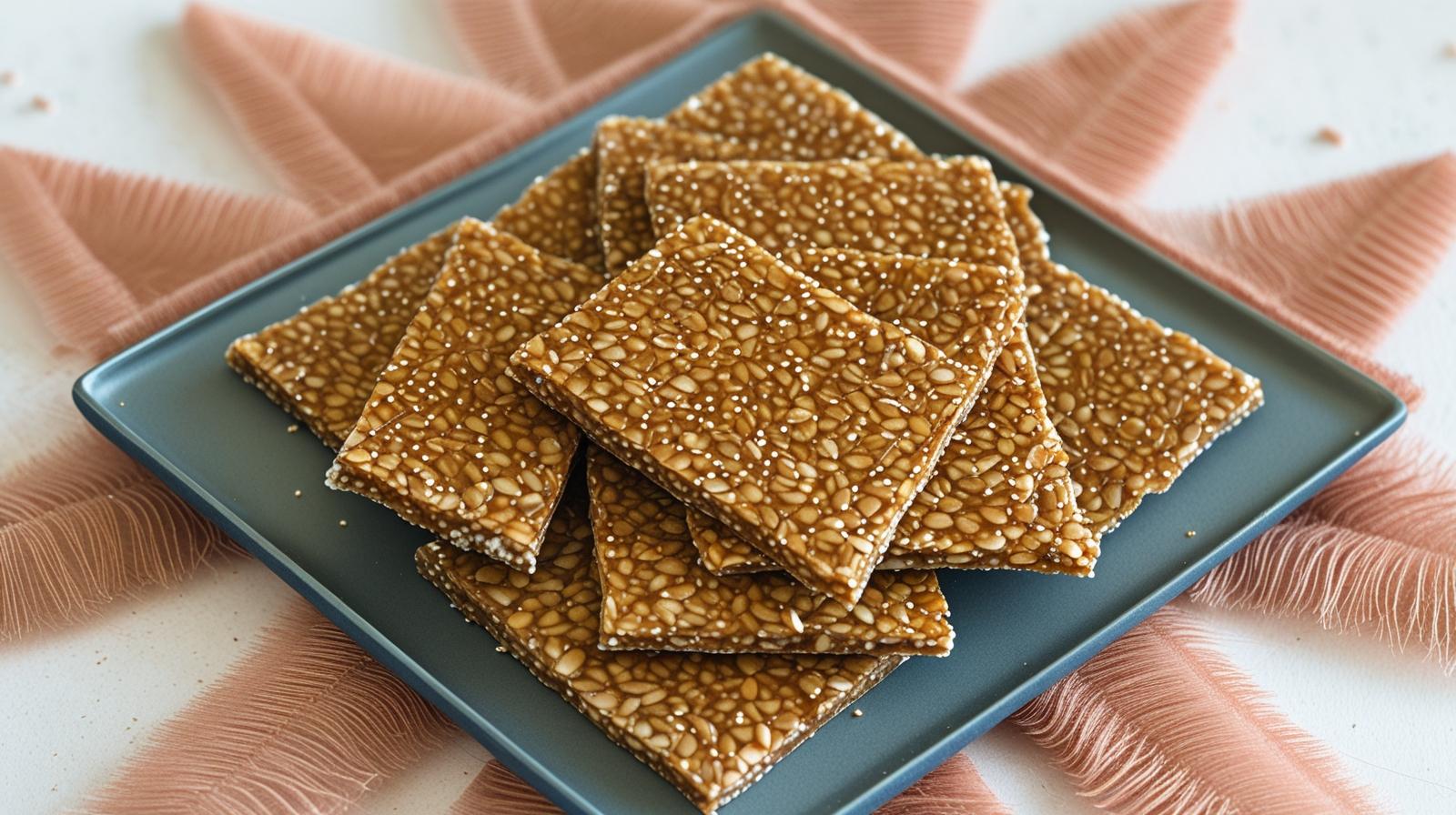
Shared by Anuja Kharod. A traditional sesame and jaggery brittle made with three ingredients: toasted tal (sesame seeds), gol (jaggery), and ghee. One of the oldest and most nutritionally complete sweets in the Indian kitchen.
Approximately 20 to 25 pieces
Bone density, hormone support, iron, sustained energy
2 to 3 weeks in an airtight container at room temperature
A note about Anuja Kharod
Anuja Kharod is a loving aunt whose knowledge of cooking flows directly from her parents, carrying forward the food wisdom of her family with care and generosity. She is a woman who takes care of the entire home, and it shows in what she makes: food that is simple, honest, and deeply nourishing. She studied in the United States, majoring in German, and as an immigrant helped settle her family in a new country. She is kind, devoted, and a great cook.
Tal ni Chikki is the kind of recipe that lives in family memory rather than cookbooks. A handful of ingredients, a kadai, a thali, and the knowledge of exactly when the jaggery is ready. Anuja knows.
What you need
- --1 cup sesame seeds (tal), toasted on low flame until lightly golden
- --1 and 1/2 cups jaggery (gol), roughly broken or grated
- --1/2 cup ghee (Anuja uses 1/2 cup; the original note says 3 to 4 tablespoons but she finds 1/2 cup gives the right consistency)
Equipment: A heavy kadai or thick-bottomed pan. A greased thali (flat plate or tray) or greased baking sheet. A greased spatula or flat spoon for spreading. Work quickly once the sesame goes in: the mixture sets fast.
How to make it
In Anuja's words, exactly as she shared them:
- 1Toast the tal on a low flame until lightly brown. Set aside.
- 2In the same kadai, add the ghee and melt it.
- 3Add the gol. Let it melt completely until the ghee separates from the jaggery. This is the sign the jaggery is ready.
- 4Add the toasted tal immediately and mix everything together quickly.
- 5Immediately spread the mixture onto a greased thali in an even layer.
- 6Cut into pieces while still warm and pliable.
- 7Let it cool completely before lifting the pieces. It will crisp and harden as it cools.
The critical moment
Once the ghee separates from the melted jaggery, the mixture is at the right stage. Do not cook further or it will become too hard. Add the sesame immediately and move fast. The whole process from adding the sesame to spreading on the thali takes about 30 seconds.
Greasing
Grease the thali generously with ghee before you begin cooking so it is ready the moment you need it. You cannot pause to grease it once the mixture is in the pan.
About this recipe
Tal ni Chikki is one of the most ancient sweet preparations in the Indian kitchen. Sesame and jaggery together appear in texts on Indian festivals, seasonal eating, and Ayurvedic diet going back thousands of years. In many parts of India, particularly in Maharashtra and Gujarat, sesame and jaggery sweets are specifically associated with Makar Sankranti, the winter festival that marks the sun's northward journey, because both ingredients are warming, strengthening, and appropriate for cold-weather eating.
From a nutritional standpoint, this is an extraordinary combination. Sesame seeds contain 1450 mg of calcium per 100 grams according to the National Institute of Nutrition (ICMR), making them one of the highest plant sources of calcium available, higher per gram than dairy. Jaggery provides iron, magnesium, potassium, and the trace minerals that refined sugar strips away. Ghee provides the fat-soluble medium that carries sesame's Vitamin E and fat-soluble lignans into the body, and its butyric acid supports the gut microbiome that converts those lignans into their active phytoestrogenic forms.
Three ingredients. Thousands of years of use. And the science to explain all of it.
Why this recipe supports you
- ◆Sesame contains 1450 mg of calcium per 100 grams (ICMR), directly supporting bone density as estrogen declines
- ◆Sesame lignans (sesamin) are converted by gut bacteria to enterolactone, a phytoestrogenic compound that gently supports hormone balance
- ◆Sesame selenium supports liver detoxification of excess estrogen metabolites
- ◆Jaggery provides iron, directly relevant for perimenopausal women managing heavy or irregular periods
- ◆Jaggery magnesium supports sleep quality and nervous system calm
- ◆Jaggery potassium supports cardiovascular health, increasingly important as estrogen's protective effect diminishes
- ◆Jaggery provides a gentler glycemic response than refined sugar, with its molasses content slowing glucose absorption
- ◆Ghee butyric acid supports gut lining integrity, directly relevant for the gut microbiome that converts lignans to their active forms
- ◆Ghee fat carries sesame's fat-soluble Vitamin E into the bloodstream, supporting hormonal health and skin
- ◆The combination of sesame calcium, jaggery iron, and ghee fat-soluble carriers is more bioavailable than any of the three ingredients alone
Ingredients and their wisdom
Sesame seeds, toasted (1 cup, tal or til)
Thermal quality: Warming. The calcium, lignans, and bone-building foundation of this recipe.
Ayurveda
Sesame (Tila) holds one of the highest places in Ayurvedic dietary medicine. It is Brimhana (tissue-building), Balya (strengthening), Vrushya (reproductive tonic), and specifically Asthi-posaka, nourishing to bone tissue. Black sesame is considered more potent but white sesame, which is most commonly used in chikki, carries the same fundamental properties. Ayurveda specifically recommends sesame for Vata conditions, for the cold and dry season, and for women in midlife as a tissue-nourishing and hormone-supporting food.
TCM
Black sesame seeds (Hei Zhi Ma) are a classical Jing tonic in TCM, used specifically to nourish Kidney and Liver Essence, strengthen bones, moisten the intestines, and nourish Blood. White sesame carries similar properties at a slightly milder level. The Kidney governs the bones in TCM, and foods that nourish Kidney Essence support bone integrity as Jing gradually declines with age. Sesame is one of the primary foods recommended in TCM dietary therapy for women in midlife specifically for this reason.
Nutrition
Sesame contains 1450 mg of calcium per 100 grams according to the National Institute of Nutrition (ICMR), making it one of the highest plant sources of calcium available. One cup of sesame seeds (approximately 140 grams) means a single batch of this chikki contains over 2 grams of calcium across all the pieces, a meaningful contribution per serving. Sesame's lignans, particularly sesamin, are converted by gut bacteria to enterolactone, a phytoestrogenic compound that gently supports hormone balance and has been associated with reduced breast cancer risk in multiple population studies.
Jaggery (1 and 1/2 cups, gol or gur)
Thermal quality: Warming. The iron, mineral, and sweetness layer that refined sugar can never replicate.
Ayurveda
Jaggery (Guda) is classified in Ayurveda as one of the healthiest sweeteners. Its sweet rasa nourishes Vata, builds Ojas (vital essence), and provides Brimhana (tissue-nourishing) action. Unlike refined sugar, which Ayurveda considers ama-producing, jaggery retains the molasses content of sugarcane, making it a whole food with nutritional value rather than empty calories. Ayurvedic texts specifically recommend jaggery in winter preparations as a warming, blood-building food.
Nutrition
Jaggery provides iron in a bioavailable form, particularly relevant for perimenopausal women who may still be experiencing heavy or irregular periods and are at risk of iron depletion. It also provides magnesium, potassium, and zinc in small but meaningful amounts. Its glycemic response is gentler than refined sugar because the molasses slows glucose absorption, making it a more appropriate sweetener for women managing the blood sugar dysregulation that perimenopause introduces.
Ghee (1/2 cup)
Thermal quality: Neutral to slightly warming. The bioavailability carrier, the binder, and one of Ayurveda's most important foods.
Ayurveda
Ghee (Ghrita) is classified in Ayurveda as the single most important Ojas-building food. It nourishes all seven dhatus (body tissues), is one of the few foods considered beneficial for all three doshas, and is specifically Medhya (mind-nourishing) and Vrushya (reproductive tonic). In combination with sesame and jaggery in a winter preparation, ghee occupies its classical role as the Anupana, the carrier that delivers the active compounds of the other ingredients deep into the tissues.
Nutrition
Ghee's butyric acid directly supports the gut lining, maintaining intestinal integrity and supporting the microbiome that converts sesame lignans to their bioactive phytoestrogenic forms. This is a functionally important chain: sesame lignan precursors require a healthy gut microbiome to become active, and ghee directly supports that microbiome. Ghee also provides the fat-soluble medium in which sesame's Vitamin E and fat-soluble compounds dissolve, making them significantly more bioavailable than sesame consumed without fat.
Storing and serving
Once completely cool, store the chikki pieces in an airtight container at room temperature. They keep well for 2 to 3 weeks. In dry climates they may keep longer. Do not refrigerate: the cold and moisture will make them sticky rather than crisp.
Eat one or two pieces as a mid-morning or mid-afternoon snack alongside a warm cup of tea. This is the traditional way: a small piece of chikki, a cup of chai or one of the herbal brews from this collection, a few minutes of pause. The combination of sesame calcium, jaggery iron, and ghee fat provides sustained energy without a blood sugar spike, making it one of the most satisfying and genuinely nourishing snacks available.
In Gujarati and Maharashtrian households, talni chikki appears at festivals, in winter months, and whenever someone needs building up. It is offered to guests, packed in tins for family far away, and made in large batches that last the season. It is food that carries love and intention alongside its nutrition.
Sources and references
National Institute of Nutrition (ICMR). Calcium Rich Food Items: Nutrient per 100g of Edible Portion. Indian Council of Medical Research, Hyderabad.
Wu WH et al. Sesame ingestion affects sex hormones, antioxidant status, and blood lipids in postmenopausal women. Journal of Nutrition. 2006.
Frawley D, Lad V. The Yoga of Herbs: An Ayurvedic Guide to Herbal Medicine. Lotus Press. 1986.
Maciocia G. The Practice of Chinese Medicine. Churchill Livingstone. 2008.
Lad V. Textbook of Ayurveda: Fundamental Principles. Ayurvedic Press. 2002.
Bloom in the pause.