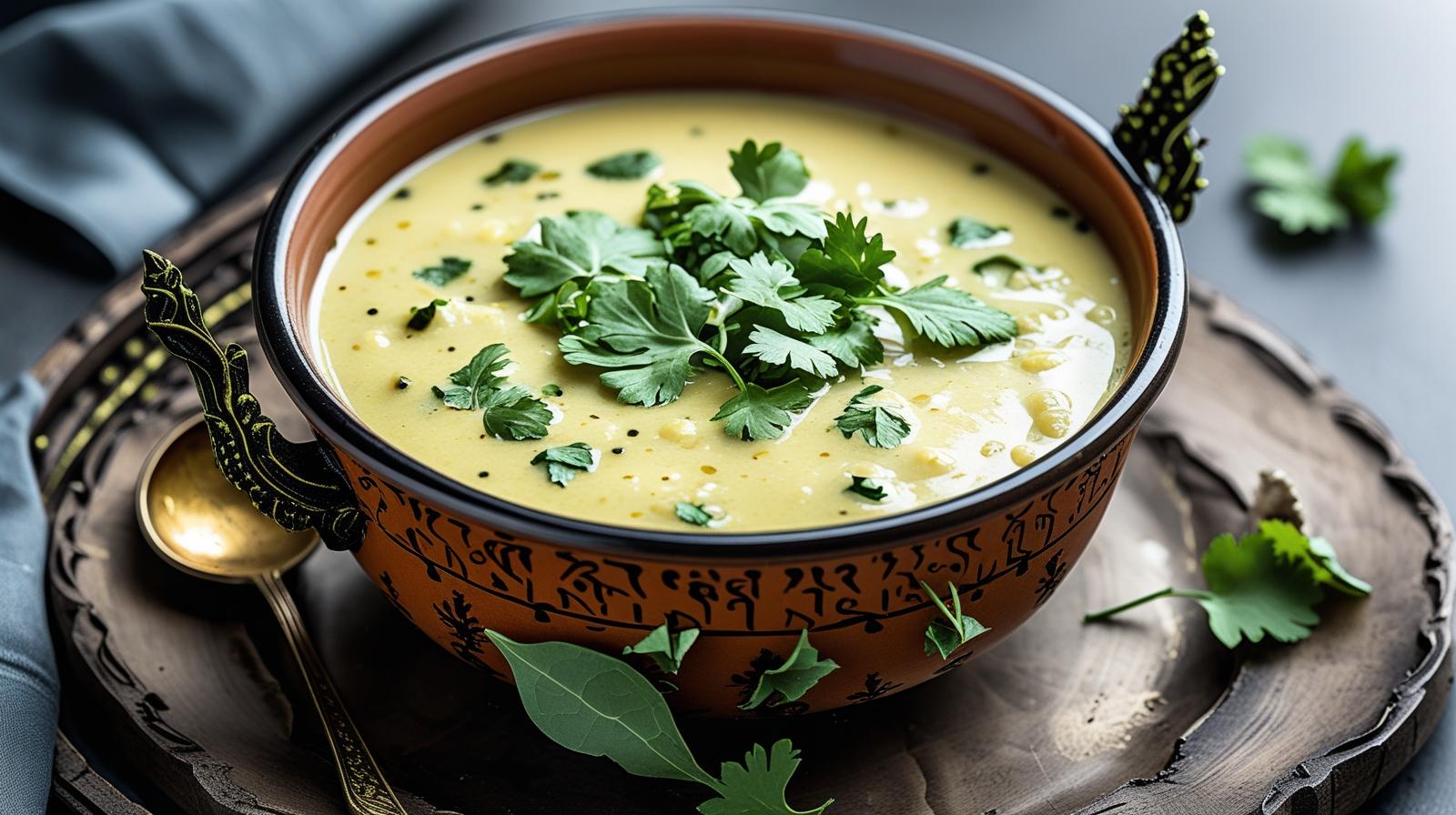
A tangy, golden yogurt and chickpea flour broth tempered with spices that together provide protein, digestive support, blood sugar support, and some of the most clinically studied herbs for perimenopausal hormone balance.
10 minutes
15 to 20 minutes
3 to 4 as a main with rice or chapati, or 2 as a standalone bowl
Plant protein, gut health, blood sugar stability, hormone support, digestive comfort
What you need
For the kadhi base
- --1 container (32 oz) organic whole milk yogurt (or low-fat; both work)
- --1/4 to 1/2 cup besan (chickpea flour, also called gram flour): use 1/4 cup for a thinner kadhi, 1/2 cup for a thicker one
- --Water: enough to make the total liquid around 4 cups; adjust to your preferred consistency
- --Salt, to taste
- --Jaggery, a couple of pieces (optional; traditional in Gujarati kadhi; adds a gentle sweetness that balances the tang; use solid jaggery pieces, not powder or syrup)
For the tempering (tadka)
- --2 to 3 tablespoons coconut oil (melted) or peanut oil
- --1/2 teaspoon mustard seeds (or more if you prefer)
- --1 to 1.5 teaspoons cumin seeds
- --1 teaspoon fenugreek seeds (methi seeds)
- --5 to 7 fresh sweet curry leaves if large, 10 to 15 if small (meetho limro in Gujarati, available at Indian stores, usually in the freezer section)
- --3/4 inch fresh ginger, shredded (optional but highly recommended)
- --1 teaspoon turmeric powder
- --1 teaspoon asafoetida (hing)
Equipment options: gas stove or Instant Pot in saute mode. A blender or Vitamix makes the base preparation effortless, but a whisk works equally well.
When this meal belongs in your day
- ◆When you want a protein-rich meal that digests easily and supports gut health
- ◆On days when your gut feels sensitive or sluggish
- ◆As a warm, grounding meal in cooler weather when you need something settling
- ◆Alongside rice or chapati for a traditional and deeply nourishing lunch or dinner
- ◆By itself as a warming broth when you want something light but sustaining
- ◆When you are watching blood sugar and want a low-glycemic, high-protein option
About this recipe
Gujarati kadhi is one of the oldest and most complete functional foods in the Indian kitchen. It has been eaten daily in Gujarati households for generations, often without any explanation beyond the fact that it feels right: warming when you are cold, settling when your stomach is unsettled, grounding when you are scattered. The science behind why it feels this way is now fairly well documented.
The base is yogurt and besan, which together provide a meaningful protein serving. Yogurt is an animal-based complete protein containing all nine essential amino acids. Besan is a good plant protein but is not complete on its own, as it is low in methionine. This is exactly why the traditional pairing of kadhi with rice or chapati is nutritionally correct: both rice and wheat are relatively rich in methionine, and together with besan they form a complete protein. This is the same logic as dal and rice, or lentils and flatbread. Traditional food combinations are frequently nutritionally precise in ways that were understood long before amino acid biochemistry.
You can make this on a gas stove in about 15 minutes, or in an Instant Pot on saute mode in about the same time. The blender method for the base is the easiest preparation approach: add water, besan, and yogurt together and blend until completely smooth and lump-free. Then pour directly into the tempering.
Why this recipe supports you
- ◆Provides a high-quality protein serving: yogurt is a complete animal protein, besan adds plant protein and prebiotic fiber
- ◆Fenugreek seeds reduce hot flash frequency and intensity in clinical trials
- ◆Yogurt diluted with water and gently heated is easier to digest than cold plain yogurt, and still carries beneficial cultures and complete protein
- ◆Turmeric reduces systemic inflammation underlying most perimenopause symptoms
- ◆Chickpea flour has a low glycemic index, supporting blood sugar stability
- ◆Curry leaves support liver function and are rich in iron, calcium, and antioxidants
- ◆Ginger reduces inflammation and improves nutrient absorption
- ◆Asafoetida prevents digestive bloating from legume flours
- ◆Cumin supports liver function and improves calcium absorption
- ◆Jaggery provides trace minerals and a gentler glycemic response than refined sugar
Why this formula works the way it does
Kadhi is not a soup with spices added. It is a spice delivery system built around a protein base that is made far more digestible by two key steps: diluting the yogurt with water, and heating it gently. The tempering sequence is pharmacological in its precision. Each spice is added at a specific temperature because different bioactive compounds release at different heat points. Mustard seeds pop and release their glucosinolates first. Cumin seeds release their cuminaldehyde next. Fenugreek releases its saponins. Curry leaves crackle and release their alkaloids. Ginger follows, then the turmeric and hing. The sequence is not decorative. It is a sequential activation of different compound classes.
The yogurt and besan base is prepared cold and added immediately once the tempering is ready. This prevents the yogurt from curdling by ensuring the tempering is distributed through the liquid before sustained heat is applied. The brief boil that follows is enough to cook the besan and stabilize the mixture. The simmer after turning off the heat finishes the process gently.
The result is a bowl where every sip delivers protein from the yogurt, prebiotic fiber from the besan, anti-inflammatory curcumin from the turmeric, phytoestrogens from the fenugreek, digestive support from the cumin and ginger, and the liver-supporting compounds of curry leaves. This is a meal that earns its place in a perimenopausal woman's daily rhythm.
Ingredients and their wisdom
Yogurt (1 container, 32 oz, organic whole milk preferred)
Thermal quality: Cooling raw, lighter and warming when diluted and gently heated. The protein foundation of the dish.
Ayurveda
Quality: Heavy (Guru), Sour (Amla), Unctuous (Snigdha), Warming (Ushna virya). Dosha effect: Nourishes Vata, reduces Vata and Pitta in the digestive system; increases Kapha and Pitta in excess. Yogurt (Dadhi) is one of the most therapeutically important dairy foods in Ayurveda, classified differently from milk: it is sour, heating, and heavier than milk, and it specifically nourishes the tissues and kindles digestive fire (Agni). In Ayurveda, yogurt is classically recommended for people with Vata imbalance, poor digestion, and depletion, all of which characterize the perimenopausal transition.
TCM
Nature: Cool to Neutral. Meridian: Lung, Stomach, Liver. Action: Nourishes Yin, generates fluids, moistens dryness, supports Stomach Qi. In TCM dietary therapy, yogurt and fermented dairy are used as Yin tonics for conditions of dryness and fluid deficiency. During perimenopause, Kidney Yin deficiency manifests as dryness throughout the body. Yogurt's moistening and fluid-generating action addresses this pattern directly.
Nutrition
Organic whole milk yogurt provides approximately 8 to 10 grams of protein per serving and is a complete protein, containing all nine essential amino acids. This is meaningful for perimenopausal women because muscle mass preservation becomes more difficult as estrogen declines, and adequate complete protein is the primary dietary lever for maintaining it. A note about lactose: yogurt is significantly lower in lactose than milk due to bacterial fermentation, making it well-tolerated by many people who find plain milk difficult.
Besan, chickpea flour (1/4 to 1/2 cup)
Thermal quality: Neutral. The thickener, the plant protein contribution, and the prebiotic fiber source.
Ayurveda
Quality: Light (Laghu), Dry (Ruksha), slightly Cool (Shita). Dosha effect: Tridoshic in small amounts; reduces Kapha and Pitta. Besan is derived from Bengal gram, which belongs to the family of legumes considered most Sattvic, meaning most supportive of clarity and lightness. It is classified as a Deepana (digestive-stimulating) and Pachana (digestive) food. In kadhi, besan serves a structural role: it thickens the yogurt base, gives it body, and prevents the yogurt from separating when heated.
Nutrition
Besan contains approximately 22 grams of protein per 100 grams, making it one of the highest-protein plant flours available. However, besan is not a complete protein on its own: like most legumes, it is low in methionine. This is why eating kadhi with rice or chapati matters nutritionally. Both rice and wheat contain the methionine that besan lacks, completing the amino acid profile of the meal. The resistant starch and soluble fiber in besan function as prebiotics, feeding the gut microbiome bacteria that convert plant lignans into their bioactive forms.
Fenugreek seeds, methi (1 teaspoon)
Thermal quality: Warming. The most clinically documented spice in this formula for perimenopause.
Ayurveda
Quality: Heavy (Guru), Oily (Snigdha), Warming (Ushna). Dosha effect: Strongly reduces Vata and Kapha; use with awareness in high-Pitta conditions as it is heating. Fenugreek (Methi) is one of the most important women's herbs in Ayurveda, used throughout every stage of a woman's life: for menstrual regularity in the reproductive years, for lactation after childbirth, and for hormonal balance through perimenopause and menopause. Its bitter rasa reduces Kapha accumulation; its pungent quality stimulates digestive fire; its warming nature moves stagnant Vata in the reproductive and digestive channels.
TCM
Nature: Warm. Meridian: Kidney, Liver. Action: Warms Kidney Yang, disperses cold and dampness, supports reproductive function. In TCM, fenugreek (Hu Lu Ba) warms the Kidney Yang, making it appropriate for the cold patterns that accompany Kidney Yin deficiency in perimenopause: cold feet and lower back, reduced libido, and the general yang-depleted fatigue that many perimenopausal women experience.
Nutrition
A randomized double-blind placebo-controlled study in the Journal of Food Biochemistry found that 500 mg of fenugreek extract daily for 42 days produced more than a 20 percent reduction in hot flashes, night sweats, and insomnia, and more than a 30 percent improvement in depression scores in perimenopausal women. A separate randomized controlled trial found that fenugreek seed extract significantly improved sexual function and satisfaction scores. The one teaspoon in this recipe is a culinary dose, modest and appropriate for daily use.
Fresh curry leaves, meetho limro (5 to 15 depending on size)
Thermal quality: Neutral to slightly cooling. The liver tonic and iron source of this formula.
Ayurveda
Quality: Light (Laghu), Sharp (Tikshna). Dosha effect: Reduces Kapha and Pitta; neutral for Vata. Sweet curry leaves (Murraya koenigii) are classified in Ayurveda as a Deepana (digestive stimulant) and a liver-supporting herb. Their bitter rasa purifies the blood and supports liver detoxification of excess hormones and metabolic waste. In the context of perimenopause, where the liver must increasingly take over estrogen processing from the ovaries, curry leaves provide direct functional support for this transition.
Nutrition
Curry leaves are extraordinarily nutrient-dense for their small size. Their iron content is directly relevant for perimenopausal women who may still be experiencing heavy or irregular periods and are at risk of iron deficiency. Their carbazole alkaloids have documented anti-inflammatory and antioxidant properties, and their Vitamin C content supports iron absorption from the meal itself. Their calcium content (around 830 mg per 100 grams according to ICMR) is also notable: fresh curry leaves are one of the highest plant sources of calcium available.
Turmeric (1 teaspoon)
Thermal quality: Warming. The anti-inflammatory anchor of the tempering.
Ayurveda
Quality: Light (Laghu), Dry (Ruksha), Warming (Ushna). Dosha effect: Tridoshic; reduces all three doshas in appropriate amounts. Turmeric (Haridra) is one of the most used herbs in all of Ayurvedic medicine. Its primary classification is as a Rakta Shodhaka (blood purifier) and Yakrit Uttejaka (liver stimulant). In the context of kadhi and perimenopause, its most relevant action is its support of the liver in processing and clearing hormonal metabolites.
TCM
Nature: Warm. Meridian: Spleen, Stomach, Liver. Action: Invigorates Blood, moves Qi stagnation, clears Heat and dampness. In TCM, turmeric (Jiang Huang) moves Blood and Qi stagnation in the Liver channel, the pattern that underlies the irritability, tight chest, irregular periods, and emotional volatility of perimenopausal Liver Qi stagnation.
Nutrition
Curcumin, the primary active compound in turmeric, is one of the most studied natural anti-inflammatory compounds in the world. It inhibits NF-kB, one of the primary inflammatory signaling pathways involved in perimenopause symptoms from joint pain to mood disruption. The fat in the coconut or peanut oil used for the tempering enhances curcumin absorption, as curcumin is fat-soluble.
Asafoetida, hing (1 teaspoon)
Thermal quality: Warming, penetrating. The digestive protector that makes legume-based dishes safe for all constitutions.
Ayurveda
Quality: Light (Laghu), Oily (Snigdha), Warming (Ushna), Sharp (Tikshna). Dosha effect: Strongly reduces Vata; reduces Kapha. Asafoetida (Hingu) is classified in Ayurveda as one of the most important Vata-reducing spices, used specifically for digestive Vata conditions: gas, bloating, cramping, and the irregular quality of digestion that characterizes Vata imbalance. It is the classical antidote to the Vata-aggravating tendency of legumes and bean flours, which is precisely why it appears in virtually every Indian dal, kadhi, and besan preparation.
Nutrition
Asafoetida's primary bioactive compounds include ferulic acid, a potent antioxidant and anti-inflammatory, and volatile sulfur compounds that have documented antispasmodic effects on smooth muscle. These compounds directly address the digestive spasm that besan can cause. Research also suggests hing has mild antihypertensive effects and supports healthy blood pressure, relevant for perimenopausal women whose cardiovascular risk increases as estrogen declines.
Cumin seeds (1 to 1.5 teaspoons)
Thermal quality: Warming. The digestion enhancer and mineral absorption amplifier.
Ayurveda
Quality: Light (Laghu), Dry (Ruksha), Warming (Ushna). Dosha effect: Reduces Vata and Kapha. Cumin (Jeeraka) is the primary Agni-stimulating spice in the Indian culinary tradition. It improves the absorption of minerals from all the other ingredients in the dish, including the calcium from curry leaves and yogurt, and the iron from curry leaves and besan. In Ayurveda it is specifically recommended for women for conditions of Artava Kshaya, to support the reproductive system through transition.
Fresh ginger, shredded (roughly 3/4 inch)
Thermal quality: Warming. The absorption amplifier and anti-inflammatory.
Ayurveda
Quality: Warming (Ushna), Penetrating (Tikshna). Dosha effect: Reduces Vata and Kapha. Fresh ginger (Ardraka) in kadhi serves two functions: it amplifies digestion by stimulating the entire digestive chain from salivary enzymes to intestinal absorption, and it provides gingerols that reduce systemic inflammation. In Ayurveda it is one of the most important Vishwabheshaja herbs, the universal medicine that improves every formula it is added to.
Nutrition
Gingerols reduce inflammation through COX-2 inhibition and improve gastric emptying to ensure the protein from the yogurt and besan is fully absorbed. In the context of kadhi, ginger also prevents the mild nausea that some women experience when eating yogurt-based dishes when digestion is sluggish.
Mustard seeds (1/2 to 1.5 teaspoons)
Thermal quality: Warming. The circulatory and anti-inflammatory opener of the tempering.
Ayurveda
Quality: Light (Laghu), Warming (Ushna), Sharp (Tikshna). Dosha effect: Reduces Kapha and Vata. Mustard seeds (Sarshapa) are used in Ayurveda as a Vata-reducing, circulation-stimulating spice. When they pop in hot oil, they release sulforaphane and other glucosinolates that have documented anti-inflammatory and liver-supporting properties. The popping is important: it is the sound and visual cue that the oil is at the right temperature to proceed with the rest of the tempering. Mustard seeds that do not pop have not released their active compounds.
Fresh coriander leaves, cilantro (optional garnish)
Thermal quality: Cooling. The Pitta-clearing finishing herb that those who most dislike it may most need.
Ayurveda
Quality: Light (Laghu), Slightly Oily (Snigdha), Cool (Shita). Dosha effect: Strongly reduces Pitta; tridoshic in appropriate amounts. Coriander leaves (Dhanyaka patra) are classified as the primary antidote to Pitta aggravation, particularly Pitta in the liver and blood. They are cooling, blood-purifying, and liver-cleansing, making them a natural pairing with a dish that contains warming spices like fenugreek, cumin, and mustard seeds. Fresh coriander leaves are added raw after cooking, not cooked into the dish. Heat diminishes their cooling potency quickly.
TCM
Nature: Warming in TCM classification, aromatic, bitter. Meridian: Lung, Spleen, Stomach. Action: Counteracts the heating effects of spicy foods, supports Liver function, moves Qi. Both TCM and Ayurveda use cilantro as an antidote to spicy food and as a liver-supporting garnish, though they describe its action through different lenses.
Nutrition
Coriander leaves are nutritionally potent for their size. Their Vitamin K content supports bone mineralization alongside the calcium from the rest of the meal. Their Vitamin C enhances iron absorption from the curry leaves and besan. Research has shown that cilantro has documented heavy metal chelation properties, supporting removal of mercury, lead, and aluminum through liver and kidney pathways. One practical note: chopping the leaves finely rather than tearing them releases enzymes that break down the aldehyde compounds and significantly reduces any soapy quality for those sensitive to it.
Coconut oil or peanut oil (2 to 3 tablespoons)
The tempering fat that carries all the spice compounds and delivers them to the base.
Both oils work well. Coconut oil gives a subtle sweetness that complements the tangy yogurt base and is appropriate for Vata and Pitta constitutions. Peanut oil has a higher smoke point and a more neutral flavor, making it slightly better for a hotter tempering. Both are stable at the moderate heat of this cooking method and provide the fat-soluble medium that delivers curcumin from the turmeric and the volatile oils from the other spices into the final dish.
Jaggery (optional, a couple of pieces)
The traditional sweetener that makes this unmistakably Gujarati.
Gujarati kadhi is traditionally slightly sweet. The jaggery is not noticeable as sweetness but rounds the tartness of the yogurt and integrates the spices into a more harmonious flavor. In Ayurveda, jaggery (Guda) is considered healthier than refined sugar because it retains trace minerals including iron, magnesium, and potassium, along with a gentler glycemic effect. A couple of pieces in this quantity of kadhi is well within a safe range for women monitoring blood sugar.
How to make it
Prepare the base
Combine the yogurt, besan, and water. The blender method is the easiest: add the water first, then the besan, blend until smooth, then add the yogurt and blend again briefly. The blender ensures a completely lump-free base, which produces a silky kadhi. If you do not have a blender, whisk the besan into a small amount of yogurt first until no lumps remain, then whisk in the rest of the yogurt and the water. Either way, the base should be completely smooth before cooking. Add salt and jaggery (if using) to the base now, before cooking.
Make the tempering (tadka)
Heat the oil in a pot on medium heat on a gas stove, or on saute mode in the Instant Pot. The order matters: add mustard seeds and wait for them to pop (this tells you the oil is hot enough). Add cumin seeds and fenugreek seeds together and let them sizzle for 10 to 15 seconds. Add the fresh curry leaves (they will crackle and release their aroma; stand back slightly as they can spatter). Add shredded ginger and stir for about 10 seconds. Add turmeric and asafoetida and stir quickly for about 5 seconds. The tempering is now ready.
Add the base and bring to a boil
Immediately pour the yogurt and besan mixture into the pot over the tempering. Stir well to combine everything. On gas: bring to a boil over medium heat, stirring frequently to prevent the bottom from catching. Once it reaches a full boil, turn off the heat and let it simmer on residual heat for another 5 minutes. Kadhi has a tendency to boil over quickly once it reaches temperature, so watch it closely in the final minute. In the Instant Pot on saute mode: watch closely and as soon as it begins to boil, turn off the saute function and let it rest in the warm pot for a few minutes.
Taste and adjust
Taste before serving. Adjust salt. If it is too tangy, add a small amount of additional jaggery. If you want it thicker, let it simmer a minute longer. If you want it thinner, add a small amount of warm water and stir.
Serve
Serve warm in a bowl by itself, or with rice, chapati, or alongside the ragi sesame crackers from this recipe collection. Fresh chopped coriander leaves on top are optional but worth trying. See the coriander note in the ingredient section above for more on why those who dislike it may benefit most from it.
Ritual guidance: when and how to eat this
When
Kadhi is traditionally eaten at lunch or dinner in Gujarati households, rarely for breakfast. It is a warming, grounding meal that settles the digestive system rather than waking it up, making it most appropriate for the second half of the eating day. As a standalone bowl it is light enough for an early dinner. With rice or chapati it is a complete and sustaining main meal. It is particularly well-suited to days when digestion is sluggish, the body feels depleted, or you want something deeply nourishing without effort.
How much
One to two cups as a main bowl is a meaningful serving that delivers a full dose of the spices and a useful amount of protein. If eating with rice or chapati, a smaller bowl of kadhi as an accompaniment is the traditional Gujarati ratio.
What to pair with
- ◆Steamed rice: the classic pairing. Rice supplies the methionine that besan lacks, completing the amino acid profile of the meal. The starch also absorbs the kadhi beautifully.
- ◆Chapati or bhakari: wheat is similarly rich in methionine and completes the protein profile in the same way as rice. Scooping the kadhi with flatbread is the other traditional method and slightly more filling.
- ◆The ragi sesame crackers from this recipe collection: dipping crackers into warm kadhi adds ragi calcium and seed lignans alongside the protein of the kadhi.
- ◆A small side of cooked greens: drumstick leaves, amaranth, or spinach alongside kadhi creates an extraordinarily calcium-dense meal.
What to avoid alongside
- --Cold food or cold drinks at the same meal: yogurt-based dishes are most beneficial when the digestive system stays warm.
- --Eating it ice-cold from the refrigerator: always reheat kadhi before eating. Cold kadhi is harder to digest and reduces the bioavailability of the fat-soluble spice compounds.
Variations
This recipe is Namita's version. Classic Gujarati kadhi has many variations across families and regions.
- ◆Add a small handful of spinach or baby kale to the base before the final simmer. Both add iron and calcium and soften gently into the kadhi without changing the flavor significantly.
- ◆For heat: add a pinch of red chili powder to the tempering alongside the turmeric. Or drop 1 to 2 whole dry red chilies into the hot oil at the start. Or add fresh green chilies or sliced jalapeno alongside the ginger. The fresh chili gives the brightest heat, the dry red chili gives a deeper roasted warmth, and the chili powder blends most invisibly into the dish.
Common questions
Why does my kadhi sometimes curdle or separate?
This happens when yogurt is added to oil that is too hot, or when the mixture is stirred while cold yogurt hits a very hot surface. The blender method helps because the base is room temperature and completely smooth before it hits the tempering. Stirring constantly for the first minute after adding the base also prevents separation. If your kadhi does separate slightly, keep stirring over low heat and it will usually come back together.
Can I use low-fat yogurt?
Yes. Low-fat yogurt produces a thinner, slightly lighter kadhi. The protein benefits are similar to whole milk yogurt. The main difference is in texture and the richness of the final dish.
Can I make this without a blender?
Absolutely. Whisk the besan into a few tablespoons of yogurt until completely smooth, then whisk in the rest of the yogurt, then the water. The key is ensuring no lumps remain before adding the mixture to the tempering. A lumpy base will produce a lumpy kadhi. Spend two minutes whisking thoroughly and the result will be excellent.
Is this safe if I have thyroid issues?
The ingredients in this recipe are generally thyroid-friendly when eaten as part of a varied diet. However, fenugreek in large daily amounts may affect thyroid hormone levels in some individuals. The one teaspoon used here is a culinary dose and well within a safe range for most people. If you have thyroid concerns or are on thyroid medication, check with your healthcare provider.
Why add the fenugreek seeds at the same time as cumin rather than later?
Fenugreek seeds need slightly more time in the oil than most other spices to mellow their bitterness and release their active saponins. Adding them with the cumin (rather than after the curry leaves and ginger) gives them the few extra seconds they need. If you add them last they can remain slightly bitter and astringent in the final dish.
Sources and references
Khanna A et al. Efficacy of a novel extract of fenugreek seeds in alleviating vasomotor symptoms and depression in perimenopausal women: A randomized, double-blinded, placebo-controlled study. Journal of Food Biochemistry. 2020.
Thomas JV et al. Phytoestrogenic effect of fenugreek seed extract helps in ameliorating the leg pain and vasomotor symptoms in postmenopausal women. ScienceDirect. 2020.
National Institute of Nutrition (ICMR). Calcium Rich Food Items: Nutrient per 100g of Edible Portion. Indian Council of Medical Research, Hyderabad.
Frawley D, Lad V. The Yoga of Herbs: An Ayurvedic Guide to Herbal Medicine. Lotus Press. 1986.
Maciocia G. The Practice of Chinese Medicine. Churchill Livingstone. 2008.
Lad V. Textbook of Ayurveda: Fundamental Principles. Ayurvedic Press. 2002.
Bloom in the pause.