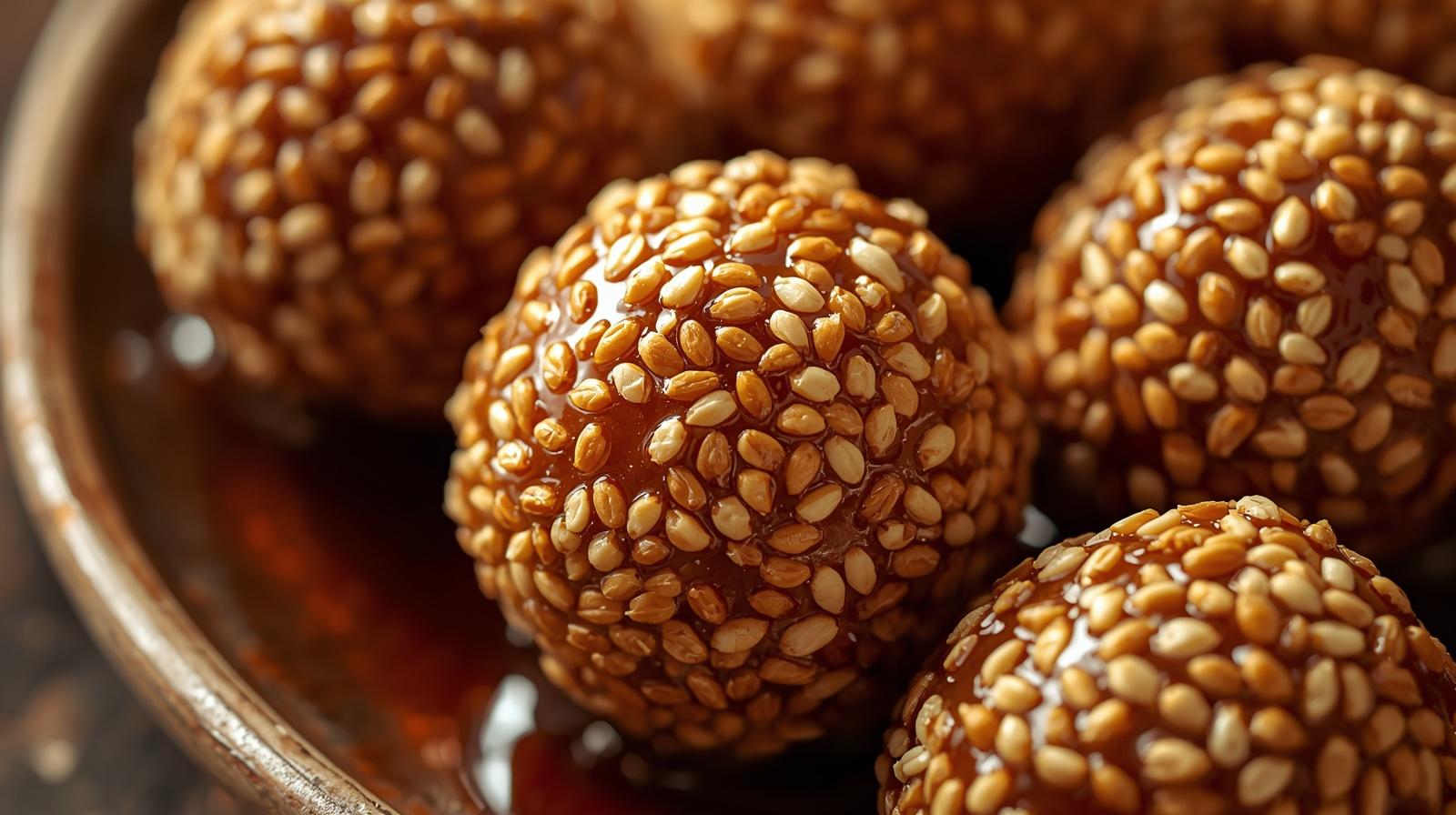
Sesame and jaggery rolled by hand into small warm balls with just a whisper of ghee. A simple, ancient Gujarati sweet made for Makar Sankranti and through the cold months. Shared by Meeta Ghoda.
15 to 20 small ladoos
2 to 3 weeks at room temperature; do not refrigerate
Meeta Ghoda, Junagadh, Gujarat
Bone density, iron, hormone balance, a warming nourishing sweet, post-workout or winter snack
A note about Meeta
Meeta Ghoda is a loving grandmother and a great cook from Junagadh, Gujarat, one of the oldest and most historically rich cities in India. Junagadh sits at the foot of the Girnar hills, home to ancient Jain temples, the rock edicts of Emperor Ashoka dating to the third century BCE, and the Uparkot Fort that has stood for over two thousand years. It is a city where layers of civilization sit one on top of another, and where the cooking traditions are just as ancient and just as carefully kept.
Tal na Ladu and Gol Papdi both come from Meeta's kitchen. They are two expressions of the same deep Gujarati tradition of making simple, honest sweets from whole ingredients that nourish the body through the cold months.
What you need
- •1 cup sesame seeds (tal), dry roasted
- •1 cup jaggery (gol), grated or finely crumbled
- •1 tablespoon ghee
Note on ghee
Just 1 tablespoon is all this recipe needs. The jaggery does the binding work. The ghee lightly greases the kadai, helps the jaggery melt evenly, and coats your palms when rolling to prevent sticking.
How to make it
- Dry roast the sesame seeds in a pan on medium-low heat, stirring continuously, until they begin to pop and jump and smell toasty and nutty. Remove from heat immediately and set aside.
- In the same kadai, add the tablespoon of ghee and the grated jaggery. Heat on a low flame, stirring, until the jaggery melts completely and the mixture is smooth and fluid.
- Add the toasted sesame seeds to the melted jaggery and mix everything together quickly.
- While the mixture is still warm and pliable, take small amounts and roll between your palms into compact round balls. Work quickly before the mixture cools and becomes too stiff to shape.
- Keep the ladoos small. Roll gently without squeezing or pressing too hard: a light rolling motion is enough to bring them together.
- Place on a plate and allow to cool and set completely.
Roll while warm
The window for rolling is short. Once the mixture cools it becomes too firm to shape. If it sets before you finish rolling, you can briefly return the pan to very low heat for a few seconds to soften it again. Grease your palms lightly with ghee to prevent sticking while you roll.
The popping sound
The sesame seeds are ready when they begin to pop and jump in the dry pan. Do not let them darken too much or they will taste bitter. Remove from heat the moment you hear the popping and smell the nuttiness.
Why this recipe supports you
- •Sesame contains 1450 mg of calcium per 100 grams (ICMR, National Institute of Nutrition), directly supporting bone density as estrogen declines
- •Sesame lignans convert in the gut to enterolactone, a phytoestrogenic compound that gently supports hormone balance
- •Sesame selenium supports liver detoxification of excess estrogen metabolites
- •Jaggery provides bioavailable iron, directly relevant for perimenopausal women managing heavy or irregular periods
- •Jaggery magnesium supports sleep quality and nervous system calm
- •Jaggery potassium supports cardiovascular health as estrogen's protective effect diminishes
- •The very small amount of ghee supports fat-soluble nutrient absorption from the sesame without the heavier Kapha quality of a larger quantity
- •Dry roasting the sesame seeds improves their digestibility in Ayurveda by reducing their raw Kapha quality and activating their warming properties
- •The compact small size makes it easy to eat one or two as a snack without overconsuming
Ingredients and their wisdom
Sesame seeds, dry roasted (1 cup, tal or til)
Thermal quality: Warming. The calcium, lignan, and bone-building foundation.
Ayurveda: Sesame (Tila) is one of the most revered seeds in Ayurvedic dietary medicine. It is Brimhana (tissue-building), Balya (strengthening), Vrushya (reproductive tonic), and specifically Asthi-posaka, nourishing to bone tissue. Dry roasting is the Ayurvedic preparation that activates sesame: it reduces the raw, heavy Kapha quality of untoasted seeds, improves digestibility, and concentrates the warming energy. The popping sound when sesame is properly toasted is the signal that it is ready.
TCM: Black sesame seeds (Hei Zhi Ma) are a primary Kidney and Liver Essence tonic in TCM. White sesame carries similar properties at a slightly milder level. The Kidney governs the bones in TCM, and foods that nourish Kidney Essence support bone integrity as Jing declines with age. Sesame is one of the primary foods recommended in TCM dietary therapy for women in midlife specifically because it addresses both Kidney Yin depletion and Liver Blood deficiency simultaneously.
Sesame seeds contain 1450 mg of calcium per 100 grams (ICMR, National Institute of Nutrition), making them one of the highest plant sources of calcium available. Their lignans, particularly sesamin, are converted by gut bacteria to enterolactone, a phytoestrogenic compound with documented hormonal activity. Sesame also provides selenium, which supports the liver's detoxification of estrogen metabolites.
Jaggery (1 cup, grated)
Thermal quality: Warming. The iron, mineral, and binding sweetness.
Ayurveda: Jaggery (Guda) is the preferred sweetener in classical Ayurvedic cooking, far superior to refined sugar because it retains the molasses, minerals, and warmth of its source. It is Brimhana (nourishing), Rakta Prasadaka (supporting healthy blood formation), and warming. In Tal na Ladu, jaggery serves the additional structural function of binding the sesame seeds into a cohesive ball without requiring large amounts of fat.
TCM: Jaggery is not a classical TCM ingredient but its properties correspond clearly to foods that nourish Blood and warm the middle Jiao. Blood deficiency is one of the two primary patterns of perimenopause alongside Kidney Yin deficiency: fatigue, pale complexion, poor sleep, emotional instability, and palpitations all point to insufficient Blood. Jaggery's iron content and warming sweetness place it in the category of Blood-nourishing foods alongside red dates, longan, and black sesame.
Jaggery provides bioavailable iron in a form supported by its molasses co-factors. Its magnesium supports sleep and nervous system calm. Its potassium supports cardiovascular health as estrogen's protective effect diminishes with the perimenopausal transition.
Ghee (1 tablespoon)
Thermal quality: Neutral to slightly warming. The Ojas-building carrier, present in a modest but meaningful amount.
Ayurveda: Ghee (Ghrita) is classified in Ayurveda as the single most important Ojas-building food, nourishing all seven dhatus (body tissues) and benefiting all three doshas. Even at one tablespoon, ghee carries its essential qualities: butyric acid for gut lining integrity, and fat-soluble vitamins A, D, E, and K for bone density and hormonal health. In Ayurveda, ghee acts as an Anupana, a carrier that drives the active compounds of whatever it is combined with deeper into the tissues.
TCM: Ghee's properties correspond to what TCM classifies as a food that supplements Jing and nourishes the Kidney and Liver: dense, oily, warming, and tissue-building. Its butyric acid directly supports the gut lining and the gut microbiome, and in TCM the health of the middle Jiao determines how well all nourishment is absorbed and transformed into usable Blood and Essence. At one tablespoon, it prevents the jaggery from sticking, helps it melt evenly, and coats the palms during rolling.
Storing and serving
Once completely cooled and set, store in an airtight container at room temperature. Tal na Ladu keeps well for 2 to 3 weeks in dry conditions. Do not refrigerate: the cold makes them sticky and affects the texture.
Eat one or two as a mid-morning or mid-afternoon snack, alongside chai or one of the herbal brews in this collection. They are small by design, easy to eat without overconsuming, and satisfying in a way that speaks to the density of what they contain.
In Gujarati homes they are made in winter, shared at Sankranti, and packed into tins for family and friends as a gesture of care and nourishment.
Sources
- •National Institute of Nutrition (ICMR). Calcium Rich Food Items: Nutrient per 100g of Edible Portion. Indian Council of Medical Research, Hyderabad.
- •Wu WH et al. Sesame ingestion affects sex hormones, antioxidant status, and blood lipids in postmenopausal women. Journal of Nutrition. 2006. doi:10.1093/jn/136.5.1270
- •Frawley D, Lad V. The Yoga of Herbs: An Ayurvedic Guide to Herbal Medicine. Lotus Press. 1986.
- •Maciocia G. The Practice of Chinese Medicine. Churchill Livingstone. 2008.
Try the variation
Tal ni Chikki uses the same three ingredients pressed flat into a brittle instead of rolled into balls. Different shape and texture, same sesame-jaggery-ghee nourishment. Shared by Anuja Ghoda, Meeta's daughter-in-law.
Tal ni Chikki: Sesame and Jaggery Brittle