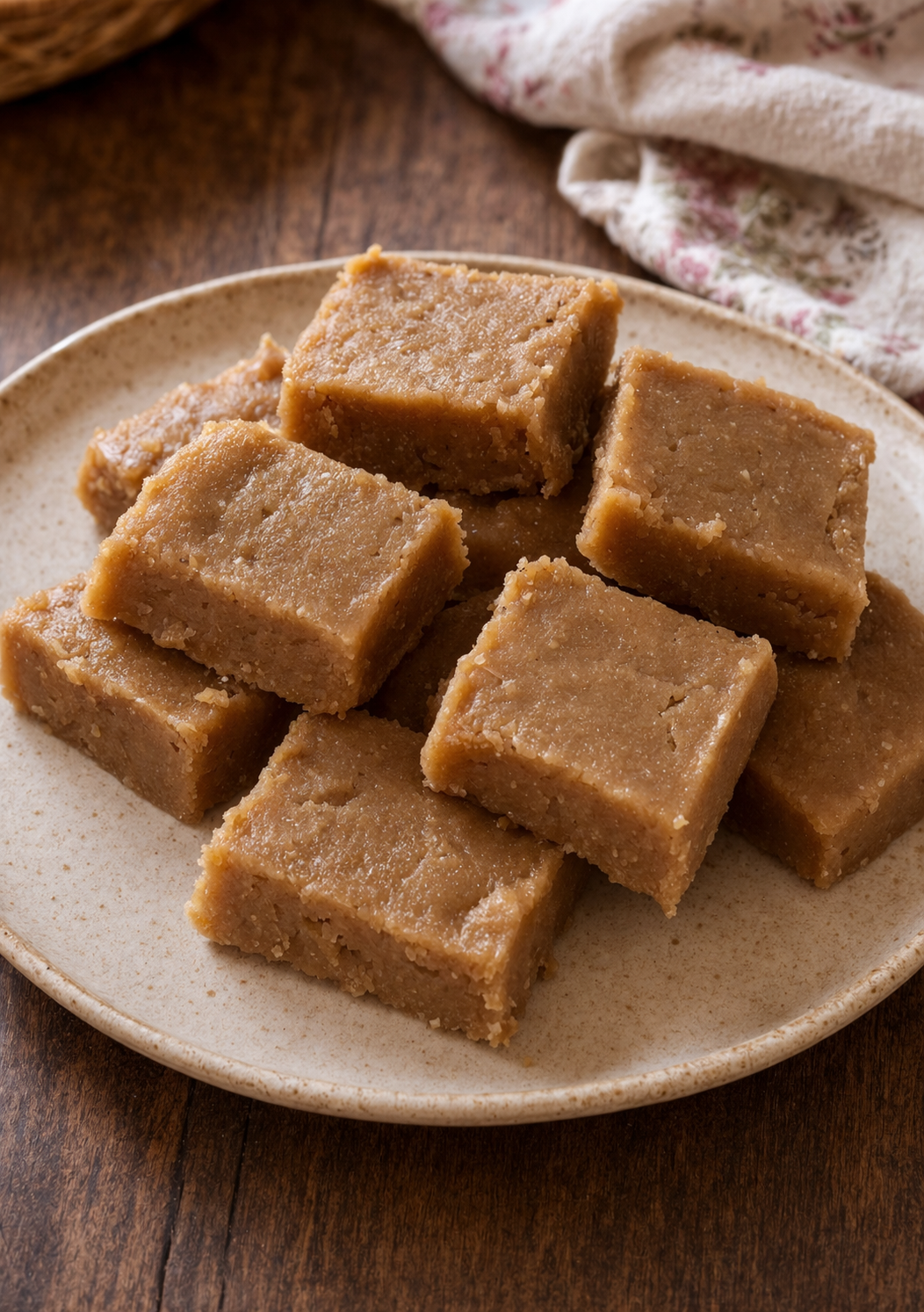
Shared By
Meeta Ghoda
Meeta Ghoda is from Junagadh, Gujarat, one of the oldest and most historically rich cities in India. Junagadh sits at the foot of the Girnar hills, home to some of the most ancient Jain temples in the country, the rock edicts of Emperor Ashoka dating to the third century BCE, and the Uparkot Fort that has stood for over two thousand years. It is a city where layers of civilization sit one on top of another, where the cooking traditions are just as ancient and just as carefully preserved.
Meeta is a loving grandmother and a great cook. Gol Papdi is exactly that kind of recipe: three ingredients known to every Gujarati kitchen, a method passed from hand to hand across generations, and a result that is simple, honest, and deeply good.
The ratio
1 part ghee, 2 parts flour, 1 part jaggery. Use the same cup throughout so the proportions stay true. This is how traditional Indian recipes hold their ratio across any batch size: the vessel is the measure.
What you need
Use the same cup for all three measurements.
- ◆1 cup ghee
- ◆2 cups whole wheat flour
- ◆1 cup jaggery, grated or finely crumbled
Equipment: A heavy kadai or thick-bottomed pan. A greased thali or flat tray ready before you start. Work quickly once the jaggery goes in: the mixture sets fast as it cools.
How to make it
- Heat the ghee in a kadai over a low flame.
- Add the wheat flour and roast slowly on a low flame, stirring continuously so it does not stick or burn.
- Roast for 15 to 20 minutes until the flour turns golden and smells fragrant and nutty. Do not rush this step on high heat.
- Remove from heat. Add the grated jaggery and mix quickly and thoroughly. The heat of the roasted flour will melt the jaggery as you stir.
- Immediately spread the mixture onto a greased thali in an even layer.
- Cut into squares or diamond shapes while still warm and pliable.
- Let it cool and set completely before lifting the pieces.
The roasting step
This is the heart of the recipe and cannot be rushed. Low heat, continuous stirring, 15 to 20 minutes. The flour must turn a warm golden color and develop a deep, nutty fragrance before you take it off the heat. Underroasted flour will taste raw. Overheated flour will burn and turn bitter. The color and smell tell you when it is ready.
Jaggery off the heat
Add the jaggery after removing from the flame. The residual heat of the roasted flour mixture is enough to melt it. Adding jaggery over direct heat risks burning the sugar. Mix fast and get it onto the thali immediately.
About this recipe
Gol Papdi, also called Sukhdi in parts of Gujarat, is one of the most ancient and widely made sweets in Gujarati cuisine. It is a winter sweet, made during the cold months when the body calls for warmth, nourishment, and the deep sustaining energy that ghee and jaggery provide together. It appears at festivals, at religious occasions, in dabbas packed for travel, and in the hands of grandmothers who make it from memory without measuring a thing. The three-ingredient simplicity is deceptive: this is a recipe with deep roots in Ayurvedic nutritional thinking, not a shortcut.
From a nutritional standpoint, Gol Papdi is an Ayurvedic preparation in the most literal sense. Whole wheat flour provides complex carbohydrates, B vitamins, fiber, and plant protein. Ghee provides butyric acid for gut lining integrity, fat-soluble vitamin carriers, and Ojas-building nourishment. Jaggery provides iron, magnesium, potassium, and the Madhura rasa that nourishes depleted tissue and calms Vata. Together they form what Ayurveda calls a Brimhana preparation: building, warming, and specifically appropriate for times of depletion.
Why this recipe supports you
- ◆Ghee butyric acid supports gut lining integrity and the microbiome that regulates hormone metabolism
- ◆Ghee provides fat-soluble vitamin carriers A, D, E, and K, supporting bone density and hormonal health
- ◆Whole wheat flour provides B vitamins including B6, which supports progesterone production and GABA synthesis
- ◆Wheat fiber supports the estrobolome, the gut bacteria that clear excess estrogen rather than allowing it to recirculate
- ◆Jaggery provides bioavailable iron, directly relevant for perimenopausal women managing heavy or irregular periods
- ◆Jaggery magnesium supports sleep quality and nervous system calm
- ◆The combination of complex carbohydrates and ghee fat provides sustained energy without blood sugar spikes
- ◆As a warming Brimhana preparation it is particularly appropriate in cooler months and for Vata-dominant constitutions
- ◆Eaten in moderate amounts as an occasional sweet it is genuinely nourishing rather than merely indulgent
Ingredients and their wisdom
Whole wheat flour (2 cups)
Thermal quality: Neutral to slightly warming when roasted. The complex carbohydrate and B vitamin foundation.
Ayurveda: Wheat (Godhuma) is classified in Ayurveda as sweet, cooling, heavy, and nourishing. It is Brimhana (tissue-building), Balya (strengthening), and one of the most sattvic of the grains. Roasting in ghee transforms wheat from a cooling to a warming food, changes the digestibility by dextrinating the starches, and produces the deep nutty fragrance that signals the Maillard reaction has occurred and the grain is ready. In Ayurveda, roasted grains are easier to digest than raw or simply cooked ones.
Whole wheat flour provides B vitamins including B6, which is a cofactor in progesterone synthesis and in the production of GABA, the calming neurotransmitter whose decline contributes to the anxiety of perimenopause. Its fiber content supports the estrobolome, the collection of gut bacteria that bind and eliminate excess estrogen rather than allowing it to be reabsorbed into circulation.
Ghee (1 cup)
Thermal quality: Neutral to slightly warming. The Ojas-building carrier and gut-nourishing fat.
Ayurveda: Ghee (Ghrita) is the single most important Ojas-building food in Ayurvedic medicine. It nourishes all seven dhatus (body tissues), is one of the few foods considered tri-doshically beneficial, and is specifically indicated for the tissue depletion and dryness of Vata-dominant conditions such as the perimenopausal transition. In Gol Papdi, ghee is not just a cooking medium: it is the vehicle through which the flour is transformed and through which the nourishing qualities of the preparation are carried into the tissues.
Ghee's butyric acid directly supports the gut lining, maintaining intestinal integrity and reducing the inflammation that worsens during perimenopause. Its fat-soluble vitamin content, particularly Vitamins A, D, E, and K, supports bone density, immune function, and hormonal health at the cellular level.
Jaggery (1 cup, grated)
Thermal quality: Warming. The iron, mineral, and Madhura rasa layer.
Ayurveda: Jaggery (Guda) is one of the most therapeutically important sweeteners in Ayurveda, far preferable to refined sugar because it retains the molasses, minerals, and warmth of its source. It is Brimhana (nourishing), warming, and specifically Rakta Prasadaka, supporting healthy blood formation. The classical combination of ghee, grain, and jaggery in a heated preparation appears repeatedly in Ayurvedic texts as a Vata-pacifying, tissue-building preparation appropriate for depletion and recovery.
Jaggery provides bioavailable iron in a form that is meaningfully more accessible than the non-heme iron of plant foods alone, because the molasses co-factors support absorption. For perimenopausal women who may still be experiencing heavy or irregular periods, this is directly relevant. Its magnesium supports sleep quality and muscle calm. Its potassium supports cardiovascular health as estrogen's protective effect diminishes.
Storing and serving
Once completely cool, store in an airtight container at room temperature. Gol Papdi keeps well for 2 to 3 weeks in dry conditions. Do not refrigerate: the cold and moisture will make it sticky and soft rather than the clean crumbly texture it should have.
Eat one or two pieces as a mid-morning or mid-afternoon snack, alongside Traditional Masala Chai or one of the warming herbal brews in this collection. It is a winter sweet, most appropriate when the weather is cool and the body is calling for something grounding and warm. In Gujarat it is made in large batches for festivals, for travel, and to have on hand through the cold months when the body needs building up.
Also from Meeta Ghoda's kitchen
Tal na Ladu uses the same sesame, jaggery, and ghee rolled by hand into small warm balls. A different form, the same grandmother's kitchen, the same ancient Gujarati tradition.
Tal na Ladu: Sesame and Jaggery BallsSources and references
- Lad V. Textbook of Ayurveda: Fundamental Principles. Ayurvedic Press. 2002.
- Frawley D, Lad V. The Yoga of Herbs: An Ayurvedic Guide to Herbal Medicine. Lotus Press. 1986.
- National Institute of Nutrition (ICMR). Nutritive Value of Indian Foods. Indian Council of Medical Research, Hyderabad.